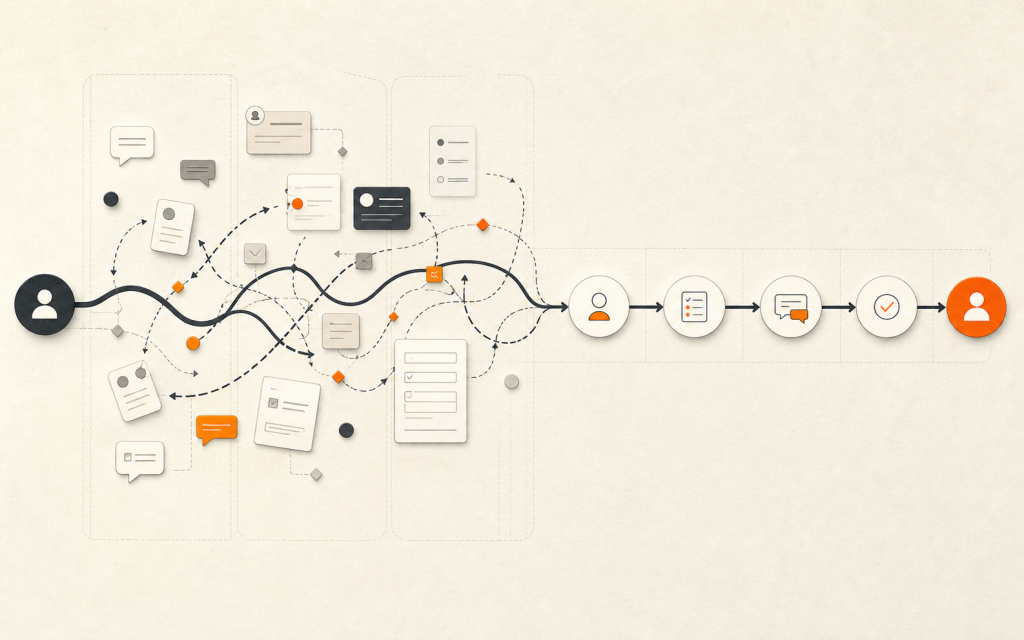
As of July 10, 2026, there is no shortage of AI activity.
There are pilots, copilots, task forces, governance decks, hiring reshuffles, vendor demos, executive memos, advisory retainers, and enough “AI-first” language to make a perfectly normal accounts-payable workflow sound like it has been cast in the next Mission: Impossible.
The market calls this momentum. Quite a lot of it is theater with a budget.
The problem is that visible AI activity is not the same thing as AI strategy. In many organizations, what looks like momentum is competitive panic: a reactive scramble shaped more by comparison, optics, and executive anxiety than by operational clarity.
It is the corporate version of watching your neighbor install a panic room and deciding your kitchen needs reinforced steel by Friday. Nobody has checked the crime rate. Nobody can find the can opener. But the contractor is already invoicing.
A company can spend aggressively on AI and still reveal strategic confusion if it has not decided what advantage it is actually trying to build.
That is the issue.
The danger is not ambition. Ambition is fine. The danger is ambition without strategic coherence. There is nothing wrong with moving quickly. The problem starts when speed becomes a substitute for thought, which is how Jurassic Park got dinosaurs before it got adequate fencing.
Ian Malcolm’s objection was not that dinosaurs lacked potential. It was that the people in charge were so preoccupied with whether they could that they did not spend enough time on whether they should. Corporate AI has produced the same meeting, except the velociraptor is a customer-facing chatbot with access to the knowledge base.
Stanford HAI’s 2026 AI Index shows how much pressure organizations are under: 88% of surveyed organizations reported AI adoption in 2025, and 70% reported using generative AI in at least one business function. The same report notes a widening gap between what AI can do and how prepared we are to manage it. That is where competitive panic grows. The technology is advancing, the market is loud, and leadership feels compelled to do something immediately, even when nobody has decided what that something should improve. In strategy language, this is urgency. In operating language, it is twelve people running through a hallway carrying different software subscriptions. Stanford HAI 2026 AI Index, Economy chapter
What competitive panic looks like
Competitive panic rarely introduces itself honestly.
It does not walk into the room and say, “We are reacting emotionally to market pressure and disguising it as innovation.”
It says:
- “We need an AI strategy now.”
- “What are our competitors doing?”
- “Which model should we partner with?”
- “How fast can we announce something credible?”
- “Do we have an AI story for clients yet?”
This is less The West Wing and more Succession: impressive rooms, urgent language, expensive clothing, and several powerful people making consequential decisions because they are terrified someone else might look more powerful first.
Those questions are not useless, but they are incomplete. They are external-facing questions before they are operational ones. They sound strategic on a slide. In a workflow, they behave like buying running shoes before checking whether the team needs to go anywhere.
A calmer strategy starts somewhere else:
- Where do we already have workflow friction?
- Where do decisions get delayed?
- Where is knowledge trapped in people instead of systems?
- Where do we have a service, process, or data advantage AI could strengthen?
- Where would better speed or judgment support create measurable value?
That difference matters because AI strategy should not begin with spectacle. It should begin with leverage.
McKinsey’s 2025 State of AI research points in the same direction. Organizations seeing more value are not merely adding tools. They are redesigning workflows, elevating governance, and changing how work moves. That is less glamorous than “we launched an AI initiative,” but closer to reality. A tool layered onto a weak operating model does not become transformation. It becomes the same disorder with autocomplete, like Michael Scott declaring bankruptcy by shouting the word and waiting for accounting to feel the impact. McKinsey, The state of AI in 2025, McKinsey, How organizations are rewiring to capture value
Why copying momentum creates weak decisions
One of the most common AI mistakes is confusing market movement with strategic fit.
If a frontier lab releases a new capability, a major platform adds AI to its product suite, or a competitor publishes a glossy announcement, the pressure spreads fast. Suddenly leadership wants to know why the company is not moving just as visibly. Entire internal conversations bend around the fear of looking behind, which is how intelligent adults end up making decisions with the emotional posture of a middle-school lunch table.
Then the sequencing goes wrong.
First comes the tool conversation. Then the messaging. Then the task force. Then the pilot. Somewhere much later, if everyone still has the energy, somebody asks what workflow is supposed to improve.
It is Ocean’s Eleven assembled in reverse: first recruit eleven charismatic specialists, then buy the equipment, then pose near the fountain, and only afterward ask whether there is a casino to rob. Stylish motion is not a plan.
Tool-first activity creates the illusion of progress. Leadership can say something is happening. Procurement gets a task. Marketing gets a phrase. The organization gets movement before it gets meaning.
Practical nugget: If your AI roadmap begins with tool selection instead of workflow diagnosis, you may already be reacting more than strategizing.
Copying momentum produces four predictable weaknesses.
1. Spending becomes a substitute for clarity
Large budgets create the appearance of seriousness, but they do not answer the strategic question. Money can buy access, experiments, consultants, and infrastructure. It cannot decide what kind of advantage the organization should create.
This is why some AI programs sound impressive in quarterly language and strangely vague in operational language. The board hears “a multi-phase AI investment strategy.” The team hears, “We bought several expensive ingredients and expect dinner to introduce itself.”
It is the Tony Stark theory of transformation: put enough money, screens, and glowing blue components in one room and assume strategic intelligence will emerge. Unfortunately, most companies do not have JARVIS. They have six disconnected dashboards and Gary from operations, who is now expected to reconcile them before lunch.
The business implication is simple: spending should follow a defined advantage, not impersonate one.
2. Visibility gets overvalued
Competitive panic rewards what can be announced, not what can be integrated.
Organizations prioritize demonstrable AI features over durable operational improvement. The initiative becomes easier to talk about than to use. It photographs well in a strategy deck, which is a very elegant way of saying the workflow is still a mess, but now it has professional headshots.
That contradiction matters because visibility creates false confidence. A feature that demos well can still collapse in real use if the surrounding process is unclear, the review model is weak, or nobody has defined what good output means. The applause at the demo does not survive contact with Tuesday morning.
3. Internal focus gets fragmented
When AI urgency is driven by comparison, the organization chases too many directions at once. Different teams test different tools. Governance appears late. Ownership gets blurry. Technical staff are pulled into initiatives that are more symbolic than strategic.
The company calls this “transformation,” one of those polished corporate nouns that can mean almost anything except “we designed the operating model carefully.” Fragmentation is not harmless. It burns time, diffuses responsibility, duplicates effort, and makes it hard to tell whether the company is building a capability or simply collecting AI-shaped activities.
4. Real strengths get neglected
This may be the most damaging effect.
Many companies already possess the raw material for a meaningful AI strategy: valuable workflows, customer knowledge, recurring operational patterns, internal bottlenecks, specialized content, service logic, or decision-heavy processes that could benefit from better retrieval, summarization, routing, review, or support.
Competitive panic pulls attention away from those strengths and toward the outer theater of AI. The organization starts chasing the shape of someone else’s strategy instead of the substance of its own.
The strategic loss is not just wasted effort. It is the failure to strengthen the places where the company already earns trust, margin, speed, or loyalty.
A real AI strategy starts with leverage
Not every company needs a frontier-style AI posture.
Most do not. A serious AI strategy begins with a grounded question: where do we already have business-specific leverage that AI can strengthen?
That leverage might be:
- A service workflow with too much manual repetition.
- A sales process with slow follow-up or weak knowledge access.
- An operations team buried in documents, tickets, or requests.
- A decision path dependent on a few overloaded people.
- A client-facing process where speed and trust matter equally.
This is where AI becomes useful instead of performative. The goal is not to “do AI” in the abstract. The goal is to improve something the business already knows matters. That sounds almost boring besides the louder parts of the market, which is precisely why it works. Erin Brockovich did not win by announcing an enterprise-wide justice transformation framework. She found the poisoned water, followed the records, talked to the people affected, and built the case. Specificity did the heavy lifting.
AI strategy needs the same instinct: find the actual harm, delay, repetition, or decision burden. Then work the evidence. The leather jacket is optional.
Practical nugget: A company-specific AI advantage is almost always more valuable than a borrowed AI narrative.
Governance cannot be treated as cleanup after the fun part. NIST’s AI Risk Management Framework keeps the conversation practical: govern, map, measure, and manage. In plain language: define responsibility, understand context, evaluate risk, and determine how the system will be controlled in real use.
That is not bureaucracy for its own sake. It is what prevents an AI initiative from becoming Wile E. Coyote’s latest Acme purchase: technically delivered, briefly impressive, and already positioned over a canyon. If governance arrives only after deployment enthusiasm, it is not governance. It is the person holding the tiny umbrella after gravity has made its decision. NIST AI RMF, AI RMF Core, Playbook
How to tell if your AI strategy is turning into panic
The first sign is usually not bad technology. It is bad sequencing.
If any of the following sound familiar, the strategy may already be drifting:
- The organization can name tools but not target workflows.
- Leadership language is stronger than the operating plan.
- Teams are piloting multiple AI ideas without clear ownership.
- Success is defined by visibility instead of measurable business change.
- Governance arrived after deployment discussions.
- Nobody can explain what should remain human-controlled and why.
These are ordinary panic symptoms in business-casual clothing. Nothing looks outrageous alone. Together, they describe a company trying to steer by dashboard light while the map remains in the glove compartment.
Practical nugget: The first sign of competitive panic is usually not bad technology. It is bad sequencing.
A better sequence is straightforward:
- Identify a real workflow.
- Define the friction, delay, or decision burden inside it.
- Determine what type of AI assistance is relevant.
- Define review points, ownership, and constraints.
- Measure whether the system improves speed, quality, consistency, or trust.
This is slower than panic in week one. It is much faster than cleaning up a scattered AI posture six months later, after everyone has fallen in love with the wrong demo and named it “Phase One.”
The strategic correction
If market pressure is real, the answer is not denial. It is discipline.
Teams do need to respond to AI. The technology is too capable and economically relevant to ignore. But the response should be shaped by business reality, not by the loudest competitor in the room.
The correction is straightforward:
- Stop asking only what the market is doing.
- Start asking what the business is structurally positioned to improve.
- Stop measuring seriousness by speed of announcement.
- Start measuring seriousness by clarity of workflow and ownership.
- Stop treating AI as a symbolic layer.
- Start treating it as part of system design.
That shift changes almost everything. It moves the organization from copied momentum to strategic coherence. It turns AI from a pressurized reaction into a deliberate capability decision.
It also retires one of the market’s favorite fantasies: that urgency is evidence of competence. It is not. Your leadership off-site is urgent because a competitor used the word “agentic” twice in a press release. These are not the same emergency.
The practical consequence is that leaders must protect strategic sequencing even when the market rewards visible motion. Calm is not passivity. In a noisy market, calm can be an operating advantage.
How Absolutmedia approaches it
At Absolutmedia, we do not start with “Which AI tool should we use?” We start with the operating model.
Tools matter. But choosing one before defining the workflow is like Q handing James Bond a laser watch before anyone has assigned the mission. The useful question is where intelligence can improve a workflow without weakening responsibility, trust, or control. That is why our approach to AI consulting and AI automation begins with workflow mapping, decision points, review structures, interface behavior, and implementation logic before we recommend a system shape.
This is also why we keep returning to how to build an AI-enabled digital system without losing human control and why our broader digital systems view stays method-first. AI should enter through a real door, solve a real problem, and improve the system rather than merely improving the story told about it.
We would rather help a team build one AI-enabled workflow that improves speed, clarity, and accountability than assemble a decorative stack of AI talking points.
Next step
If your team feels genuine pressure to act on AI, do not chase the most visible announcement pattern in your market.
Choose one workflow where better retrieval, summarization, routing, review, or decision support could create a measurable advantage. Define the human control points before scaling anything. Give the work an owner. Decide what success means in operating terms.
That may feel less cinematic than “enterprise AI transformation.” It is also how serious capability begins. The Avengers did not save New York because Nick Fury circulated a thought-leadership deck about superhero synergy. They had distinct capabilities, a defined threat, and, after a considerable amount of property damage, something resembling coordination.
Your company can skip the property damage.
If you want a practical place to continue, start with our AI Consulting lane and read it alongside AI Automation for Business Workflows: Where to Start Without Overbuilding and Scalable AI Operations: From Opportunity Discovery to Repeatable Business Systems.