Most companies do not have an AI idea shortage. They have a selection, implementation, and scaling problem.
One team wants an internal assistant. Another wants to automate reporting. Marketing is testing content workflows. Operations sees opportunities in intake and routing. Leadership sees the potential, but also sees a growing collection of disconnected experiments.
The real question is not “Where can we add AI?” It is “How do we find the right opportunities, implement them responsibly, and build an operating baseline that lets the next initiative move faster?”
That is what scalable AI operations should mean. Not one enormous platform. Not automation everywhere. A repeatable way to move from business friction to a useful, governed system.
Scalability begins during discovery
AI opportunity discovery is often treated like ideation: gather people in a room, list possible use cases, rank the most exciting ones, and choose a tool. That can produce energy, but it does not necessarily produce an operational project.
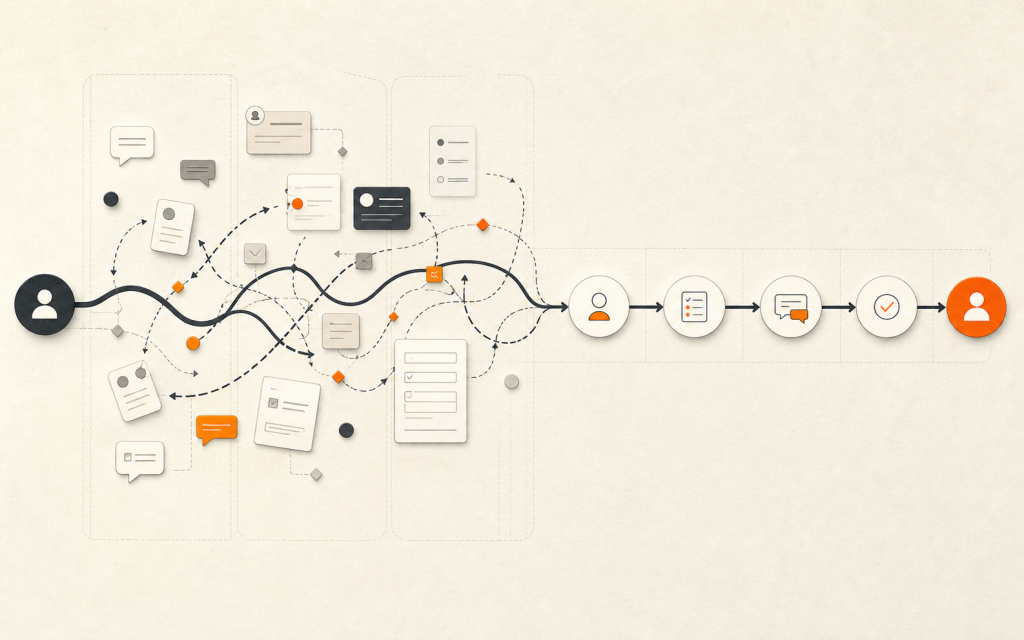
A consulting process has to look beneath the idea and map the work. Where does information enter? Who makes the decision? What knowledge is required? Which systems hold the data? Where do delays, rework, inconsistency, or handoff failures appear? What happens when the output is wrong?
This is why a workflow map is more valuable than a list of AI features. It exposes the conditions the initiative will need in order to work.
Practical nugget: If a use case cannot be described as a real flow of inputs, decisions, actions, and owners, it is not ready for implementation.
Our earlier guide to AI consulting and use case discovery covers this first stage in detail. The scaling conversation begins when the organization asks what the first implementation should teach the next one.
Select the first use case for learning value
The highest-value opportunity on paper is not always the best first project. A first initiative also needs to be bounded enough to test, measurable enough to evaluate, and connected to people who can improve the workflow.
A useful scoring model considers business value, frequency, data readiness, process stability, implementation effort, risk, and adoption. I would add one more factor: learning value.
Will this initiative teach the organization how to handle permissions, human review, evaluation, documentation, integration, or change management? If so, it can create reusable capability beyond its immediate return.
For example, an AI-assisted proposal workflow may begin inside sales. The visible benefit is faster first drafts. The deeper value may be learning how to retrieve approved knowledge, protect sensitive information, review generated output, capture corrections, and measure quality. Those same patterns can later support customer service, procurement, or internal knowledge workflows.
Practical nugget: Choose a first use case that solves one meaningful problem and exercises several capabilities the business will need again.
Build the operating baseline, not just the pilot
A pilot can work while hiding the weaknesses that will stop it from scaling. A small group may know which data to use, which outputs to distrust, and whom to call when something breaks. That informal knowledge disappears when the initiative moves to another department.
The operating baseline makes those decisions explicit. At minimum, it should define:
- Ownership: who owns the business outcome, the technical system, and output quality.
- Data boundaries: which sources the system may use, how access is controlled, and what information is prohibited.
- Human checkpoints: where a person reviews, approves, corrects, or escalates the output.
- Evaluation: how quality, time saved, error rates, adoption, and business impact are measured.
- Traceability: what is logged so the team can understand inputs, outputs, versions, and corrections.
- Change management: how users are trained, supported, and invited to improve the workflow.
The NIST AI Risk Management Framework provides a useful structure through its Govern, Map, Measure, and Manage functions. The companion AI RMF Playbook turns those functions into suggested actions that organizations can adapt to their context.
The value of these frameworks is not paperwork. It is repeatability. When governance, context, measurement, and response are designed into the first initiative, the next team does not have to rediscover them from scratch.
Scale patterns, not copies
When a pilot succeeds, the temptation is to copy it into every department. That is usually the wrong kind of scale.
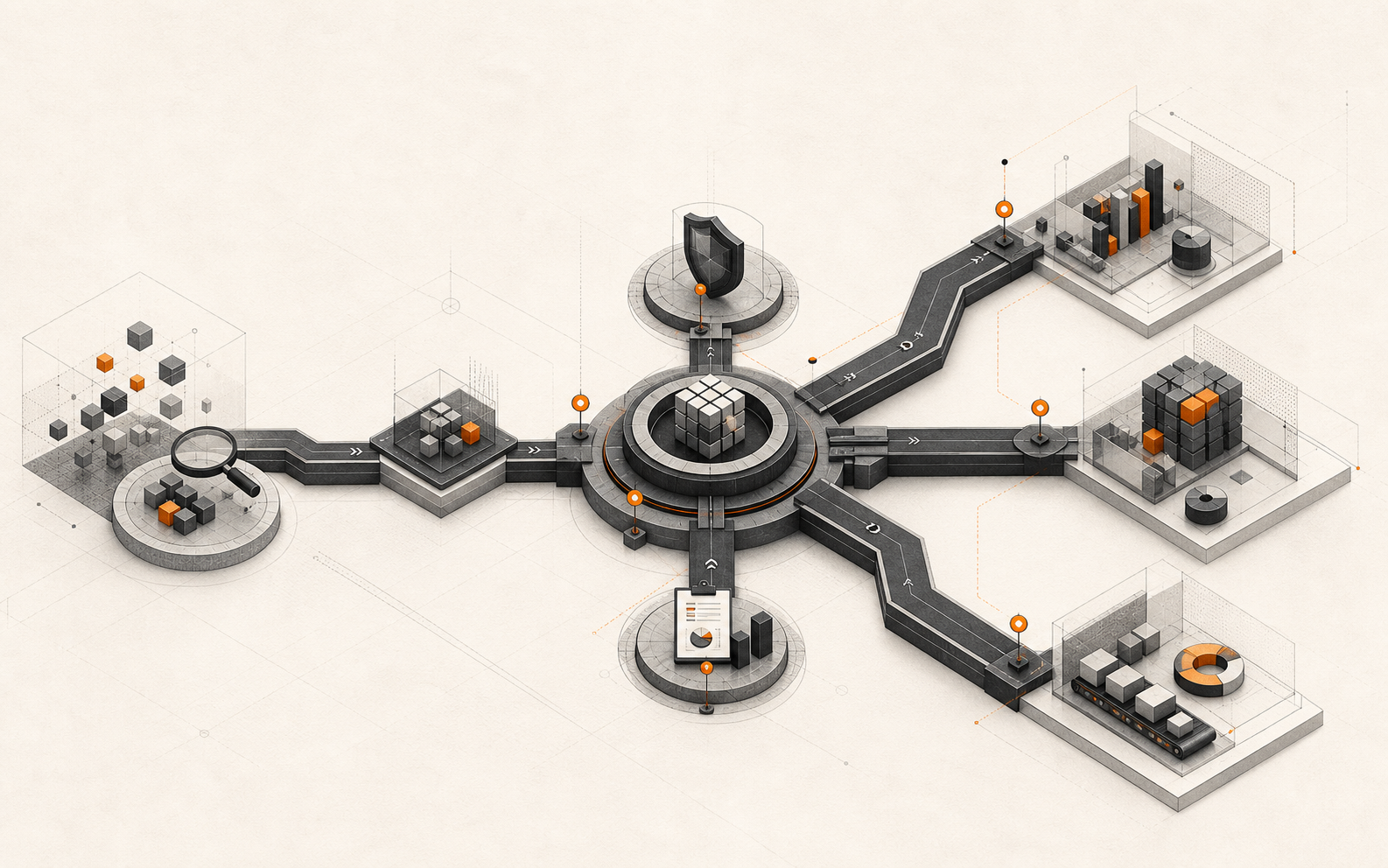
Sales, operations, finance, and client service may share a need for knowledge retrieval or document classification, but they do not share the same risk, data, language, or approval path. The reusable asset is not necessarily the finished workflow. It is the pattern behind it.
Reusable patterns may include a secure retrieval layer, an evaluation rubric, a review interface, a prompt and versioning process, an escalation rule, or a standard way to measure corrections. These components create a platform for adaptation without pretending every department works the same way.
This is also where architecture matters. An AI capability should live inside a maintainable digital system, not remain trapped in a demo. Our article on AI-enabled digital systems with human control explains why the interface, permissions, feedback loops, and visible review points are part of the product.
Practical nugget: Standardize the controls and reusable components. Customize the workflow around the people who actually perform it.
A consulting process should leave the business more capable
The best result of AI consulting is not a dependency on the consultant. It is a stronger internal ability to recognize, evaluate, and implement opportunities.
That requires artifacts the organization can reuse: an opportunity map, prioritization criteria, workflow documentation, a risk register, data and permission rules, evaluation methods, an ownership model, and a roadmap that separates immediate opportunities from foundational work.
It also requires honest decisions about what should not be automated. Some work is too variable, too sensitive, too infrequent, or too dependent on human judgment to justify AI. A mature operating model makes that visible early.
The OECD AI Principles reinforce this broader view by emphasizing human-centered values, transparency, robustness, and accountability. Those principles become practical when every initiative has named owners, visible controls, and a way to learn from real use.
What the second initiative should inherit
If the first project has created a real scalable baseline, the second initiative should not begin at zero. It should inherit a common language for value and risk, approved technical patterns, evaluation templates, data-access rules, a review model, and a clearer path through leadership and compliance.
It should still go through discovery. Scaling is not permission to skip understanding the work. It is the ability to understand the next workflow faster and implement it with fewer avoidable mistakes.
That is the quiet advantage of scalable AI operations. Each project delivers its own result while improving the organization’s ability to deliver the next one.
How Absolutmedia approaches it
We begin with the operation: the work, decisions, people, systems, constraints, and evidence of value. From there, we identify the right AI opportunities, select a useful first implementation, and design the surrounding workflow with human control, measurement, and maintainability built in.
The deliverable is not only an AI feature. It is a clearer operating model the business can reuse as new opportunities appear.
Next step
If your organization has several AI ideas but no common way to evaluate or scale them, start with one consulting sprint. We can map the opportunities, choose the right first workflow, and establish the baseline for what comes next through Absolutmedia’s AI services. When you are ready to frame the first initiative, start the conversation here.