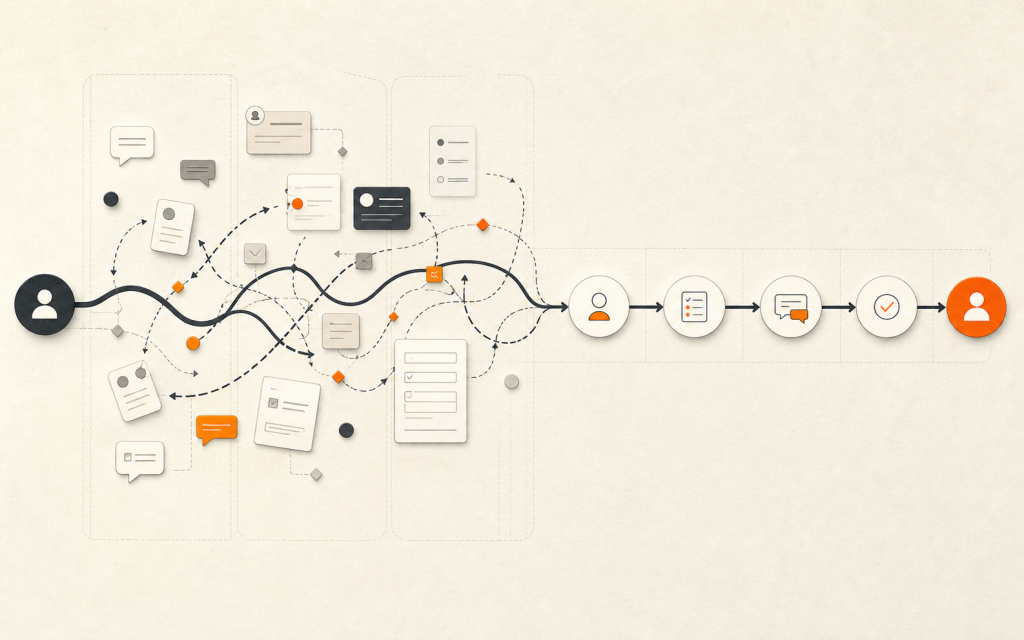
AI consulting should not begin with a vendor demo. It should begin with the work your team already does, the decisions they make every day, and the places where time, knowledge, and execution get stuck.
Enterprise teams are under pressure to “do something with AI.” That pressure can be useful if it creates momentum. It becomes dangerous when it rewards activity over method.
Discovery is not a brainstorming session
Good AI use case discovery is practical. It looks for work that is valuable, repetitive enough to support, measurable enough to improve, and safe enough to test. It also looks for the constraints: data quality, compliance, permissions, process ownership, and the human review needed before the output matters.
Practical nugget: A good AI use case has three owners: the business owner, the technical owner, and the person responsible for output quality.
That ownership structure matters because AI projects can easily drift. Everyone likes the idea. Nobody owns the result. The project becomes a prototype without a business home.
From use case to implementation
Once the use case is selected, the next question is not only “Which model?” It is “What system does this AI feature live inside?”
Will it support a CRM workflow, an internal knowledge base, a client portal, a proposal process, a content operation, a reporting system, or a custom web app? The implementation context determines the real scope.
The NIST AI Risk Management Framework is a strong reference for this stage because it encourages organizations to govern, map, measure, and manage AI risk. That language may sound formal, but the practical idea is simple: know what the system is doing and how you will control it.
Enterprise adoption is part of the design
Professionals often focus on model behavior, integrations, retrieval, prompts, and evaluation. Clients often focus on productivity and speed. Both are valid, but adoption connects them.
If the people using the system do not trust it, understand it, or know when to override it, the project will not become operational. Training, feedback loops, documentation, and visible review points belong in the implementation plan.
The IBM overview of AI in business gives a broad picture of how AI can support automation, analytics, customer experience, and operations. For an enterprise team, the useful move is to translate those possibilities into specific workflows.
The pilot should teach the organization
A pilot is not a miniature press release. It should answer practical questions: Does this save time? Is the output reliable enough? Where does human review belong? What data is missing? What breaks when volume increases? What does the team need to trust it?
Related internal reading: AI Automation for Business Workflows and Digital Product Strategy.
How Absolutmedia approaches it
We approach AI consulting as a bridge between business strategy, implementation reality, and adoption. We help define useful use cases, shape the technical path, design the surrounding workflow, and keep human judgment visible where it matters.
Next step
If your team has many AI ideas but no clear implementation path, start with use case discovery. Then work through Absolutmedia’s AI services or start a project so the idea becomes a usable system instead of a scattered experiment.