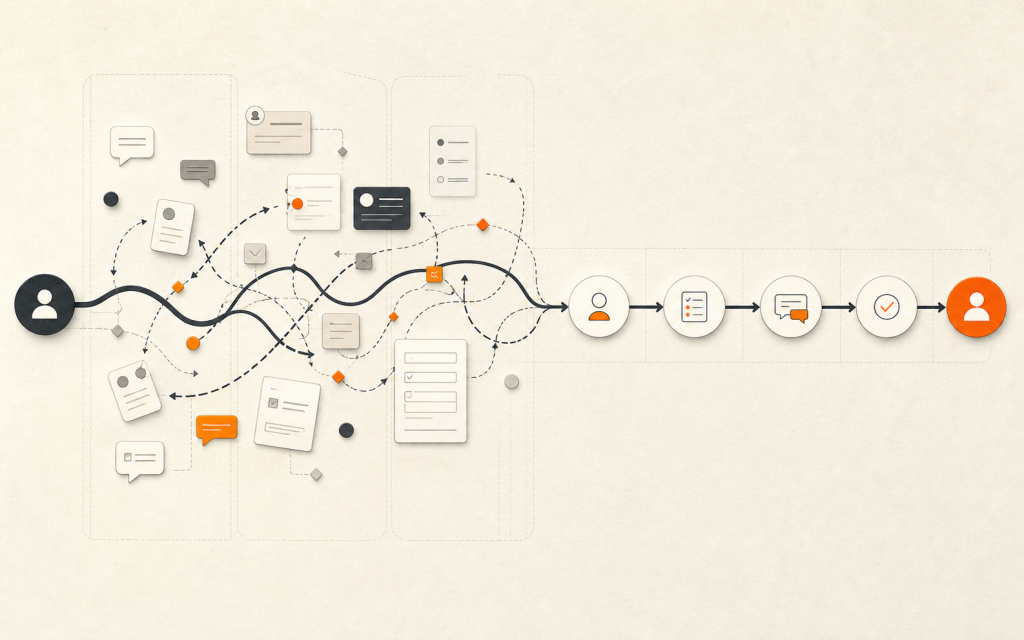
When companies worry about AI trust, they often look at the interface.
Should the chatbot disclose that it is automated? Should generated content carry a label? Should the assistant sound warm but not suspiciously warm? Can the disclaimer fit beneath the text field without making the product look like it arrived with a pharmaceutical commercial?
These are legitimate questions, and they are also the visible tip of a much larger system.
AI backlash does not begin only when a chatbot gives a bad answer. It begins when people conclude that the organizations deploying AI are careless with data, vague about accountability, indifferent to workers, addicted to scale, or using automation to avoid responsibility.
The interface may be delightful. If the system behind it behaves like the mayor in Jaws, insisting everything is fine because closing the beach would be inconvenient, the rounded corners will not save it.
The whole operating environment around the product shapes AI trust.
The chat window is the front stage
Product teams naturally focus on what users can see.
They refine the language, add explanations, adjust the tone, surface sources, tune refusal behavior, and create feedback controls. All of that matters. A clear interface can help people understand what the system is doing and where its limits are.
But the interface is the front stage. Trust is also shaped backstage.
Backstage is where the organization decides:
- What data may be collected and reused
- Whose work was involved in creating or maintaining the system
- Which outcomes are optimized
- What errors are tolerated
- Whether people can appeal consequential decisions
- Who investigates harm
- Whether leadership incentives reward restraint or merely growth
The product may look convincing from the front. The governance review begins backstage, where the operational choices become visible.
This is why “AI UX” must mean more than a conversation about design. The user experience includes what happens before the interaction, what the system does with the interaction, and what recourse exists afterward.
Practical nugget: Map the AI experience from data collection through decision, action, storage, review, and appeal. The chat window is one scene, not the whole film.
People evaluate institutions, not only outputs
The AI industry often assumes public skepticism can be solved through education.
If people understood the technology better, the theory goes, they would become more comfortable with it.
Sometimes. But this explanation can become a polite way of dismissing legitimate concern. It casts the public as a confused audience rather than people evaluating the consequences they can already see.
People may understand the central issue perfectly well: a powerful technology is being deployed by institutions whose incentives they do not automatically trust.
Pew Research Center found in 2025 that U.S. adults were much less optimistic about AI’s long-term national impact than AI experts. Yet both groups expressed concern about inaccurate information, impersonation, data misuse, bias, and inadequate oversight, and both wanted more personal control. Pew Research Center, How the U.S. Public and AI Experts View Artificial Intelligence
A later Pew study across 25 countries found that a median of 34% of adults were more concerned than excited about increased AI use in daily life, while 42% were equally concerned and excited. That is not blanket rejection. It is ambivalence: people can recognize the product’s usefulness while questioning the behavior of the institution behind it. Pew Research Center, How People Around the World View AI
Trust does not rise automatically with familiarity. It rises when capability is paired with credible behavior.
Backlash grows from adjacent harms
An AI product does not operate in isolation from the choices made around it.
People connect the technology to questions about privacy, job quality, misinformation, creative ownership, bias, concentration of power, environmental demand, and the visibility of human control. Not every concern applies equally to every system, but dismissing them as unrelated is strategically naive.
Erin Brockovich did not build a case by admiring the water company’s customer-service copy. She looked at the records, the incentives, the health consequences, and the distance between the official story and people’s lived experience.
AI trust requires the same instinct. Follow the system, not only the slogan.
Data practices become product behavior
If people do not know how their information is being used, the interface begins with a trust deficit.
A privacy notice may satisfy a formal requirement while failing the human test. “We may process information to improve services and support legitimate business interests” can conceal more than it explains.
Clear boundaries matter: what is collected, why it is needed, how long it is retained, whether it trains or improves models, who can access it, and what control the user has.
Labor choices shape legitimacy
AI changes tasks, roles, evaluation, and the distribution of work. The International Labour Organization estimated in 2025 that one in four workers globally are in occupations with some degree of generative AI exposure, while emphasizing that transformation is more likely than outright replacement because human input remains necessary. It also called for the transition to be managed through social dialogue to improve productivity and working conditions. International Labour Organization, Generative AI and jobs: A 2025 update
Organizations that introduce AI as a quiet mechanism for surveillance, work intensification, or unexplained restructuring should not be surprised when employees become skeptical. Calling it “workforce optimization” does not change the experience.
Incentives reveal the real policy
An organization may publish responsible AI principles while rewarding teams only for growth, speed, cost reduction, and engagement.
The principles are then decorative. The incentives are the operating policy.
This is the Jaws problem again: leadership says safety matters, but summer revenue keeps voting against it. Teams notice. Users eventually do too.
Accountability determines whether failure becomes scandal
All systems fail. Trust depends partly on what happens next.
Can the organization identify the failure? Can it explain what happened? Can it correct the affected outcome? Can it change the system? Is someone empowered to take responsibility without first locating a task force, a steering committee, and the legal definition of “regrettable user experience”?
When accountability is visible, a failure can become evidence of a functioning control system. When accountability is absent, the failure becomes evidence that nobody is driving.
Interface transparency has limits
Transparency is important, but it is frequently reduced to labels and disclosures.
“This content may be AI-generated” tells the user something. It does not explain whether the underlying sources are reliable, whether personal data was handled appropriately, whether a consequential decision was reviewed, or what happens if the output is wrong.
Putting a label on an irresponsible process is like adding subtitles to The Simpsons monorail episode. The audience can now read the sales pitch more clearly. Springfield still bought the monorail.
Useful transparency is contextual. It gives people the information needed to make a decision or challenge an outcome:
- When AI is materially involved
- What the system is intended to do
- Where uncertainty matters
- What information supports the result
- What control the user retains
- How to reach a human who can act
The goal is not to expose every technical detail. Nobody needs a transformer architecture lecture before checking an order status. The goal is to make responsibility legible.
Practical nugget: Do not ask only whether the system disclosed AI. Ask whether the disclosure helps a person understand, decide, or challenge.
Backlash is often delayed system feedback
Organizations sometimes treat backlash as a communications event: sentiment turns negative, criticism spreads, and a response must be prepared.
By then, the underlying problem may be months or years old.
The backlash may be delayed feedback about decisions made in product design, procurement, labor policy, data governance, incentive design, or executive communication. The public response is now visible because the system’s behavior has finally become legible.
Don Draper could rescue a difficult pitch in Mad Men. He could not permanently make a defective product trustworthy through a better tagline. Communications can clarify responsible behavior. It cannot substitute for it.
This is where controlled frustration is appropriate. Too many organizations want the social license to deploy powerful systems without doing the operational work that makes the license credible. They want trust as a conversion metric, reassurance as interface copy, and accountability in a PDF nobody can find.
People are not rejecting innovation merely because the button moved. They are asking whether the organizations behind the button deserve more authority.
Design trust across the full system
A better trust review uses five lenses.
1. Purpose
What human or business problem does the system solve, and for whom? If the only clear answer is “increase AI adoption,” the project has confused a means with a mission.
2. Boundaries
What data, decisions, and actions are inside the system’s authority? What remains prohibited or human-controlled?
3. Experience
What does the user know, choose, and control before, during, and after the interaction?
4. Operations
Who monitors performance, reviews consequential cases, handles exceptions, investigates incidents, and updates the workflow?
5. Externalities
Who bears costs that are not visible in the immediate transaction: workers, creators, communities, customers, or future teams left to maintain the system?
This final lens is where many reviews become suddenly fascinated by the meeting clock. It is also where avoidable backlash often begins.
NIST’s AI Risk Management Framework reinforces this system-level view by placing governance, contextual mapping, measurement, and active management around the full AI lifecycle. Trustworthiness is not a feature toggle. It is an organizational practice. NIST AI Risk Management Framework
How Absolutmedia approaches it
At Absolutmedia, we treat trust as an operating condition for AI-enabled digital systems.
Our AI consulting work looks beyond the model and interface to the workflow around them: data boundaries, decision rights, human control points, review paths, visible explanations, exception handling, and the incentives shaping how the system will actually be used.
This is why we connect AI strategy to digital systems rather than treating it as a floating technology initiative. A trustworthy experience is produced by the whole system. The interface is where the promise appears. Operations are where the promise is kept.
We do not believe every AI experience needs to feel defensive or bureaucratic. It needs to feel considered. A useful assistant should make the system easier to navigate, not make institutional refusal sound more personable.
Next step
Take one customer-facing or employee-facing AI experience and examine what happens beyond the screen.
Trace the data, incentives, decisions, labor, review, storage, escalation, and correction path. Identify where the organization is asking people for trust without giving them evidence of control.
Then fix the operating behavior before rewriting the reassurance copy.
The strongest defense against AI backlash is not better public relations. It is a system whose purpose, limits, and accountability remain credible when someone finally pulls back the curtain.
For related thinking, read How to Build an AI-Enabled Digital System Without Losing Human Control and AI to Produce Value or AI to Reproduce Value?.