In my family, as in many families right now, we talk about artificial intelligence all the time.
Sometimes it happens at the dinner table. Sometimes it starts in the family WhatsApp group with a link, a meme, a headline, or one of those comments that seems harmless, but after a few minutes everyone has an opinion.
Then come the arguments: the benefits, the risks, the moral questions, the ethical mess, the fear, the excitement, the irritation. AI has become one of those subjects where almost nobody enters the conversation neutral, either because you have a dog in the fight, or because you are just allergic to whatever has AI in its name.
In our case, technology has always been close to home. I have been around computers since the 1980s, and learning how to use them, apply them, and take advantage of them has been part of my personal and professional life ever since. My wife studied computer science. One of my sons studied computer systems and now works as a programmer for an important multinational company based in Monterrey. My teenage daughters are digital natives, and they are the ones who keep track of social media trends and digital culture in general.
So this is not a house where technology is treated like a mysterious object or something we use because of hype.
But even with all that background, AI feels different every time we talk about it.
Technology is a big part of my work, yes, but my most important job is still raising my children. That means helping them understand the risks that come with these tools, while also teaching them how to use technology in a way that is useful, efficient, and ethical.
That is where the work of being a father begins.
It is easy to say, “Use technology responsibly.” It is much harder to explain what that means when the technology can write, draw, code, compose music, imitate voices, generate video, and produce work that looks good enough to fool people.
My position has always been that technology should create value. It should help us learn more, work better, solve problems, or improve our quality of life. The trouble starts when someone brings up generative AI in particular.
This stage of technological development is unsettling because parents are supposed to help their children prepare for life. We try to give them tools, judgment, discipline, and some sense of direction. We want them to choose a path that lets them become useful, productive members of society.
But what do you tell them when the paths themselves are moving?
One of my daughters studies film, and she is completely against generative AI. I understand her position. In many ways, I agree with her.
The abuse is real. Many AI models have been trained on the intellectual property of filmmakers, voice actors, photographers, writers, designers, programmers, and many other creators who spent years developing their craft and building a living from it. Now their work can be absorbed, imitated, and repackaged through a prompt.
Someone types a sentence, waits a few seconds, and receives an image, a script, a song, a voice, a logo, or a block of code that carries traces of thousands of people who were never asked for permission.
That is not a small problem.
And what comes out of those models is often not brilliance. It is a statistical average of a huge amount of collective human work. Sometimes it is impressive. Sometimes it is useful. Sometimes it is completely hollow. But it is not neutral.
At the same time, I have defended some uses of generative AI.
For me, the difference is in how the tool is used. There is a big gap between using AI as part of a creative process and treating AI as the creator of the final product.
In film production, for example, I can see a legitimate use during the inspiration stage. With a simple prompt, a filmmaker can generate reference images, test visual styles, build moodboards, or explore the atmosphere of a scene. Doing that with traditional internet searches and software can take hours.
Used that way, AI is not replacing the director, cinematographer, production designer, or writer. It is helping them think faster at the beginning of the process.
That distinction matters.
There is a difference between a tool that helps a creator explore an idea and a system that lets a company avoid paying the creators whose work made the tool possible.
Lately, I have seen several content creators, especially on YouTube, publicly distance themselves from generative AI. The debates are especially ugly around music production. The comment sections are brutal.
The argument is no longer only about professional consistency, ethics, or artistic integrity. It is also about income.
Creators are seeing their livelihoods become vulnerable. Musicians are watching platforms fill with AI-generated tracks. Companies like Suno have become symbols of both possibility and threat. And the platforms are starting to react.
YouTube, Spotify, DistroKid, Apple Music, Deezer, TIDAL, CD Baby, Believe, Amuse, RouteNote, Soundrop, EMPIRE, FUGA, and other distributors or streaming services are all being forced to decide what they will allow, what they will monetize, and what they will treat as spam, impersonation, or copyright abuse.
This does not mean every platform is banning AI-generated music. The situation is more complicated than that.
YouTube requires disclosure when content is realistically generated or meaningfully altered with AI, including AI-generated music. It also says repetitive, generic, mass-produced content may not qualify for monetization if there is no clear original value.
DistroKid allows music made with AI tools, but the uploader still has to own the rights, avoid infringement, avoid impersonation, and avoid flooding platforms with low-effort content.
Spotify has moved in a similar direction. It is not saying “no AI.” It is saying no deception, no unauthorized voice cloning, no impersonation, no spam, and no attempts to manipulate the streaming system. It has also supported AI disclosures so listeners can know when AI was involved in vocals, instrumentation, lyrics, or production.
This is why the debate has become so tense.
Both sides are afraid of something real.
Artists are afraid of being replaced by systems trained on their own work. Parents are afraid their children will enter professions where originality matters less than output speed. Companies are afraid of falling behind. Creators are afraid of losing income. Technologists are afraid of rules that could slow down innovation. Audiences are afraid they will no longer know what is human, what is synthetic, what is inspired, and what is stolen.
And families like mine are trying to make sense of all this over dinner.
I do not think the answer is to reject AI completely. That does not seem realistic. In many cases, it is not even useful.
But I also do not think the answer is to applaud every new model as if speed were the same thing as progress.
A tool can be useful and still cause harm. You can use a rifle to hunt for food or to commit a crime. A technology can be impressive and still be unethical in the way it was built or deployed. Innovation does not erase responsibility.
For me, AI should help people think, learn, prototype, organize, explore, and create. It should not be used to erase the people whose work made the tool valuable in the first place.
If a filmmaker uses AI to build a moodboard, I can understand that, but if a studio uses AI to replace concept artists after training systems on the work of people like them, that is something else.
If a musician uses AI to test an arrangement, I can understand that, but if someone floods Spotify with thousands of generic tracks to extract royalties from the system, that is something else.
If a programmer uses AI to understand a problem faster, I can understand that, but If a company uses AI as an excuse to discard the people who built its products, that is something else.
So the useful question is not simply, “Was AI used?” The better questions are: who benefits, who is harmed, who gave consent, who gets credit, and who gets paid?
Practical nugget: Before approving AI use in creative or business work, name the human role first. If no one owns the judgment, the credit, the review, or the consequence, the tool is already being used badly.
That is the kind of conversation I want my children to learn how to have.
Not a lazy conversation where AI is either a miracle or a disaster. A harder one. A conversation about judgment.
Because the future will not belong only to the people who use AI for everything, and it will not belong to the people who pretend they can avoid it completely.
It will belong to people who can tell the difference between leverage and laziness, between creativity and imitation, between progress and extraction.
As a father, that is the part that matters most to me. I do not need my children to agree with me on every point. I actually hope they do not. The disagreement is useful. It forces us to think harder.
My daughter’s resistance to generative AI has made me more critical. My experience with technology has made some of her arguments more practical. Somewhere between her instinct to protect human creativity and my belief that tools can be used responsibly, there is a better conversation.
And we badly need better conversations.
Right now, the public debate around AI is getting louder, uglier, and more tribal. One side talks as if every concern is fear. The other talks as if every use of AI is theft. It is not black and white, but rather an innovative and disruptive scale of technological grays.
We need more precision. More honesty. More respect for the people whose livelihoods are being affected.
We need to defend human creativity without pretending technology will stop moving.
We need to use powerful tools without handing our judgment over to them.
And maybe, above all, we need to teach the next generation that the most important question is not whether they can use a technology, but whether they should use it, how they should use it, and what kind of person they become when they do.
How Absolutmedia approaches it
At Absolutmedia, we treat AI as a support layer for human judgment, not as a replacement for authorship, taste, or responsibility.
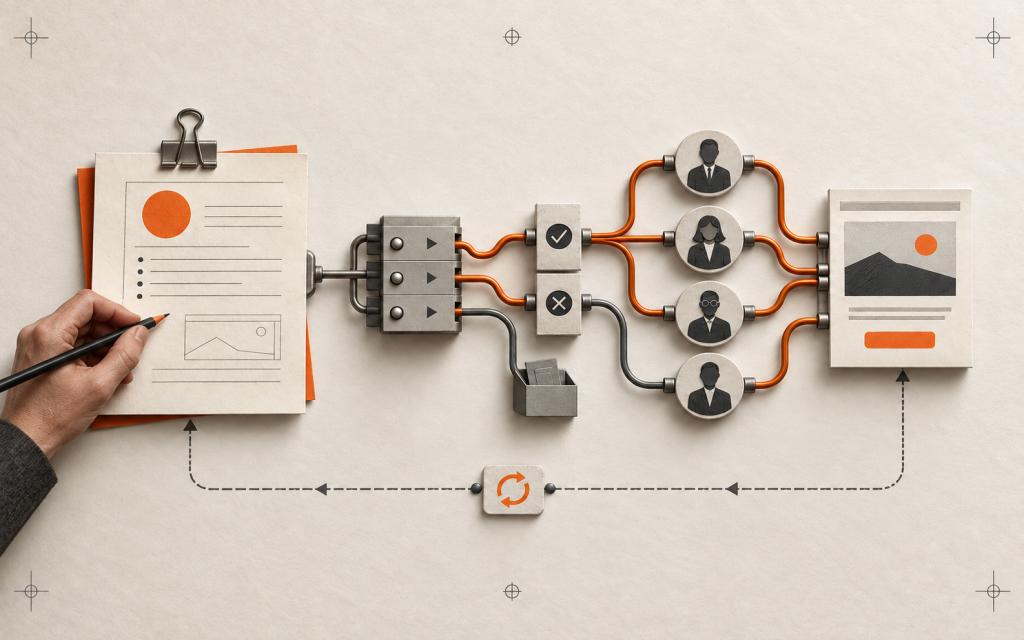
In our AI automation and AI consulting work, the conversation starts before the tool. We look at the workflow, the human review points, the risk, the data, the incentive structure, and the standard the output has to meet before it reaches a customer, a public channel, or an internal decision.
That same thinking connects to our work on AI-enabled digital systems with human control and why AI content disclosure should be part of taste and trust, not only compliance.
The goal is not to make teams afraid of AI. The goal is to help them use it with enough method, review, and ownership that the work still feels human, credible, and worth trusting.
Next step
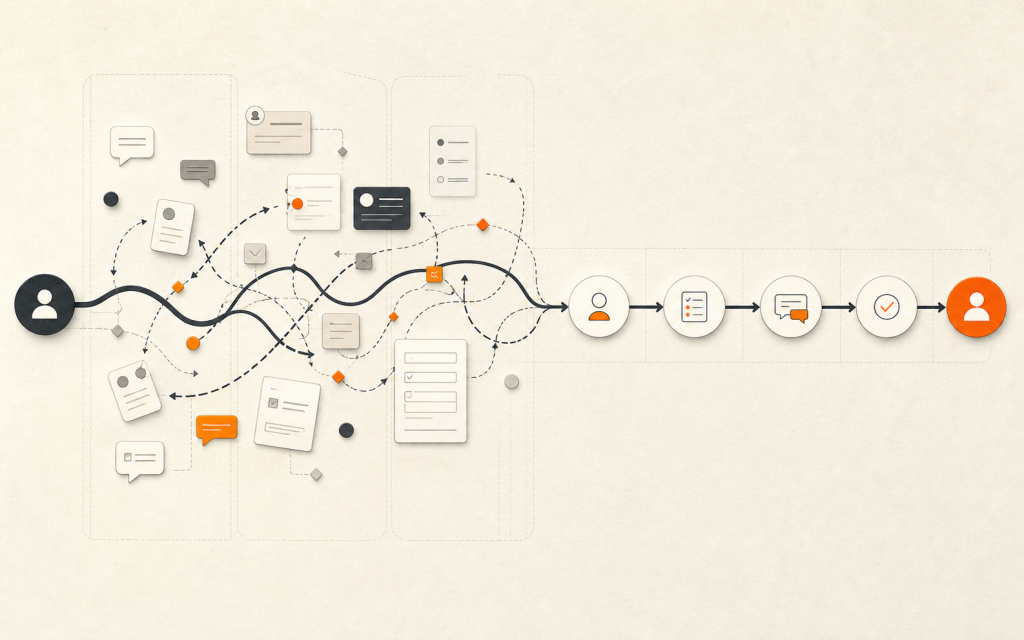
If your team is already using AI, start by mapping where it touches real work: drafts, proposals, images, summaries, code, music, customer responses, research, or internal decisions.
Then ask the uncomfortable questions early: who owns the output, who reviews it, what source material is being used, what should be disclosed, what must never be automated, and where human judgment has to stay visible.
That small map will tell you more than another tool demo.
AI usage note: This article was written with human editorial direction and review. AI tools were used in a low-risk support role for research, drafting assistance, language refinement, and structure checks. The final argument, examples, editorial judgment, and publishing decisions remain human-led.