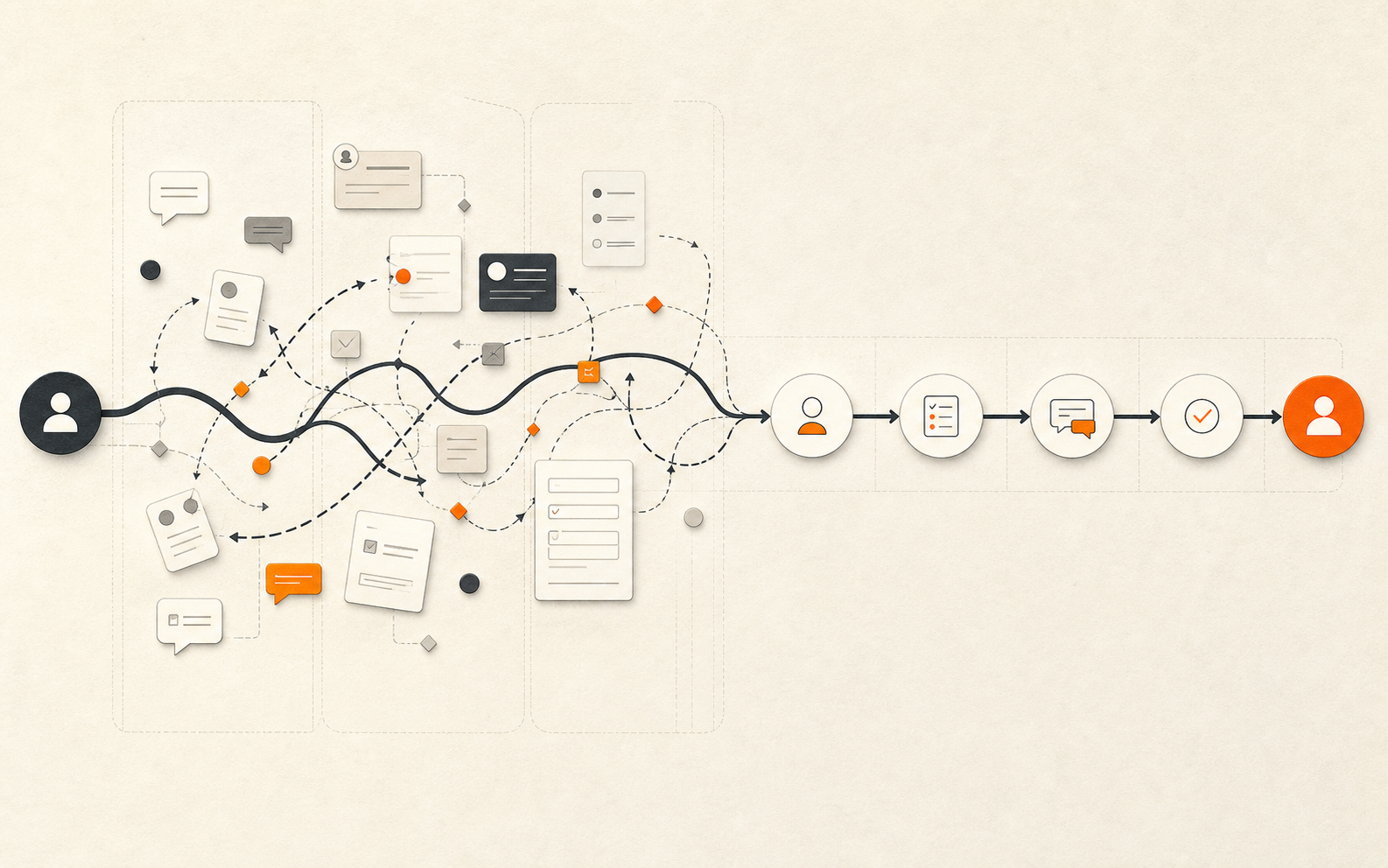
Customers do not need access to your org chart to know when your company is disorganized.
They feel it when the website says one thing and the sales call says another. They feel it when a form asks for information nobody uses. They feel it when support asks them to explain the same issue for the third time. They feel it when onboarding begins as if the sales conversation never happened.
To the company, these are internal handoffs.
To the customer, they are the brand.
That is the uncomfortable part. Most companies do not lose trust in one dramatic moment. Trust leaks through small gaps: a missing note, a vague next step, a broken confirmation email, a handoff without context, a promise that never made it from one team to the next.
The customer does not care which department dropped the ball. They only know the ball hit them.
The customer journey is not a diagram
Journey maps are useful. They give teams a shared way to see how people move from awareness to decision, onboarding, support, renewal, or referral.
But a journey map is not the journey. The journey is what happens when a real person moves through your actual systems on a Tuesday afternoon while your team is busy, your CRM has partial data, and the person who knew the context is in another meeting.
That is where the polite version of customer experience ends and the operational version begins.
Verint’s 2026 State of Customer Experience report says 51% of customers believe businesses fall short when they need help, and its trend analysis points to rising expectations, multi-channel behavior, speed, and handoffs as central CX issues. Gartner’s B2B buying journey research also reinforces the same pattern from a buying perspective: buyers want digital self-service, but they still need the right human support at the right moments, especially when confidence and context matter.
In other words, customers are not asking companies to choose between digital and human. They are asking companies to stop making the customer carry the context between them.
That is the real handoff problem.
Where the mess usually shows up
Internal mess rarely announces itself as internal mess. It shows up as something smaller and easier to underestimate.
A lead fills out a form and receives a generic email that ignores what they asked for.
A prospect reads a service page, but the sales deck uses different language, different priorities, and a different promise.
A client approves a project direction, but the production team receives a summary so thin it could double as toilet paper.
A customer starts in chat, switches to email, then calls, and each channel behaves like a separate company wearing the same logo. And don’t get me started on the inconsistencies across teams, subcontracted processes, or external tools that do not talk to each other.
That is why fixing one symptom rarely solves the problem.
Internal mess behaves a bit like a Hydra with corrosive blood: cut off one head, and two more appear somewhere else. Clean up the form, and the follow-up process breaks. Fix the sales deck, and onboarding still receives half the context. Improve the support script, and the escalation path still leaks information.
The problem is not the individual head. It is the system feeding it.
Without strategy, every fix becomes isolated maintenance. Useful, maybe. Temporary, probably.
A buyer researches the company online, then speaks with a salesperson who gives information that does not match the website. Gartner has reported that many B2B buyers see inconsistencies between information on a company’s website and what sellers provide, and that inconsistency can create mistrust.
None of these issues sound as glamorous as “digital transformation.” That may be why they survive so long.
They sit between teams. They belong to everyone just enough to be nobody’s priority.
UX is bigger than screens
Many people still use UX as shorthand for interface design. That is part of it, but it is not enough.
The interface is where the customer touches the system. The experience is everything that system remembers, forgets, routes, explains, confirms, delays, or hides.
A beautiful form that sends incomplete data to the wrong place is not good UX. It is a well-dressed inconvenience.
A clean dashboard that nobody trusts because the source data is inconsistent is not good UX. It is a confidence problem with charts.
A polished website that attracts inquiries the team cannot qualify, route, or follow up with is not good UX. It is marketing handing operations a surprise bill.
This is why digital product strategy matters before design production begins. Our article on digital product strategy makes a related point: teams need to understand the business goal, workflow, user needs, and implementation path before committing to the surface.
The screen is not separate from the workflow. It is the visible edge of it.
Handoffs need design, not hope
Most bad handoffs are not caused by bad intentions.
They are caused by unclear ownership, scattered tools, missing fields, duplicate systems, undocumented decisions, and teams that were never asked to agree on what the next person needs.
Hope is not a handoff strategy.
If marketing sends leads to sales, what information must travel with the lead?
If sales closes a project, what promise, constraint, timeline, and buyer concern must travel to delivery?
If support escalates an issue, what history, screenshots, urgency, and prior attempts must travel to the next person?
If a website captures a request, what must happen in the first five minutes, the first hour, and the first day?
These questions are operational, but they are also design questions. They decide what fields exist, what confirmation messages say, what dashboards show, what notifications trigger, and what the customer sees when the company is working behind the scenes.
This is where a service business may need more than a website redesign. Sometimes the first visible symptom is a weak page, but the actual problem is a workflow behind it. In our guide to website redesign vs. web app build, we separate communication problems from operational problems because they require different kinds of systems.
That distinction matters here. A website can clarify the offer. A digital system can help the business keep its promises after the offer is understood.
The customer should not be your integration layer
Five9 has written about why customers often have to repeat themselves, pointing to data silos, lost context across channels, and weak handoffs between systems and teams. That language may sound technical, but the customer experience is painfully plain:
“I already told you this.”
That sentence is expensive.
It means the customer is now doing unpaid administrative work for the company. They are stitching together the history, restating the urgency, correcting the record, and proving that the previous conversation happened.
Once that happens, the company has shifted its internal complexity onto the customer.
Sometimes customers forgive it. Sometimes they do not. Verint’s CX reporting highlights how thin the line has become between loyalty and churn after very good or very poor service experiences.
The practical lesson is not that every company needs a massive enterprise platform. That is usually how a simple problem becomes a procurement hobby.
The lesson is that customer-facing workflows need a continuity layer.
That layer can be simple at first: clearer forms, better routing, shared notes, consistent service language, connected status updates, better onboarding documentation, a lightweight client portal, or a dashboard that makes ownership visible.
The point is not complexity. The point is continuity. And more often than not, the human becomes the weakest link not because of incompetence or carelessness, but because the system gives them too much to remember, translate, repeat, and repair.
Practical nugget: Map the handoff before redesigning the touchpoint. If the next person, tool, or team does not receive the context needed to continue the work, the customer will feel the break no matter how polished the interface looks.
Start with the moments customers feel most
If the whole journey feels too large to fix, start with the moments where customers lose confidence.
Common places to inspect:
- The gap between website promise and sales conversation
- The gap between contact form and first human response
- The gap between proposal approval and project onboarding
- The gap between support intake and resolution
- The gap between payment and delivery visibility
- The gap between marketing content and actual service experience
For each one, ask five questions:
- What does the customer believe should happen next?
- What does the team believe should happen next?
- What information gets lost?
- Who owns the next step?
- How does the customer know progress is happening?
These questions are simple enough to answer in a workshop and serious enough to expose the real problem.
They also help decide whether the fix is content, UX, automation, integration, documentation, training, or a custom web application. Often it is a combination, staged in the right order.
Our article on UX/UI design systems focuses on consistency, accessibility, and adoption in complex products. The same logic applies to customer journeys: consistency is not decoration. It is how people know they are still in the same experience.
The brand is what survives the handoff
Companies often treat brand as the message at the top of the funnel. Logo, color, website, voice, campaign, maybe a beautiful deck if everyone behaved that quarter.
But brand also lives in the transition between departments.
It lives in whether a promise survives the move from marketing to sales.
It lives in whether context survives the move from sales to delivery.
It lives in whether empathy survives the move from support script to real resolution.
It lives in whether the customer can tell that the company is one system, not a collection of departments trying to remember what happened.
That is why internal mess becomes external experience.
Not because customers know your tools.
Because they feel the friction those tools create.
How Absolutmedia approaches it
We start by separating the visible symptom from the operating problem behind it.
Sometimes the answer is a clearer website, stronger content structure, better service pages, or a sharper conversion path. Sometimes the answer is a workflow system, client portal, internal dashboard, automation layer, or web app that gives teams a shared way to move work forward.
The method is the same: map the journey, identify the handoffs, define ownership, clarify what information must travel, and design the digital experience around the work the business actually needs to perform.
Good customer experience is not only how the interface looks. It is whether the system helps the company keep its promise.
Next step
Pick one customer journey that feels heavier than it should: inquiry to call, sale to onboarding, request to resolution, or approval to delivery.
Map the handoffs. Look for the point where context disappears.
If the issue is clarity and trust, start with the website or content structure. If the issue is ownership, routing, visibility, or repeated manual work, start with the operating system behind the experience.
Absolutmedia helps teams define that path and build the practical digital systems needed to support it.
AI usage note: This article was written with human editorial direction and review. AI tools were used in a low-risk support role for research, drafting assistance, language refinement, and structure checks. The final argument, examples, editorial judgment, and publishing decisions remain human-led.