You grab your coffee, open Meta, and click “Create campaign.”
For a moment, the targeting panel feels like the most important part of the job. You upload a customer list, add a few business interests, narrow the audience, exclude existing customers, and watch the estimated reach change until the campaign looks impressively precise.
Take a B2B software company trying to generate demand for a new revenue-operations platform. On Meta, the team might start with a customer list and layer in business interests. On Google Ads, it could choose keywords such as “CRM implementation” or “marketing attribution software.” On LinkedIn, it might select companies by industry, employee count, and job titles including VP of Marketing, RevOps Director, and CRO. On TikTok, it could build a broad professional or interest-based audience and let the platform find likely responders.
Then the team narrows, excludes, uploads lists, compares estimated reach, and adjusts the settings until the campaign appears scientifically controlled.
Some of that work still matters. But if the brief only says “reach marketing leaders at B2B companies,” the four platforms will receive the same problem in different interfaces: a defined audience, but no clear buying situation, commercial tension, proof point, or signal of valuable demand.
The center of control is shifting.
Advertising platforms are making more decisions about who sees an ad, where it appears, which version is shown, and sometimes which page receives the click. Google describes AI Max for Search as an optimization layer that uses keywords, creative assets, landing pages, and real-time signals to expand matching and tailor delivery. Meta recommends automated placements that let its delivery system distribute ads across more surfaces.
The practical meaning is not that targeting is dead. Marketing has already held enough funerals for things that remained inconveniently alive.
The useful meaning is this: when the platform controls more of the route, the quality of your strategic inputs matters more.
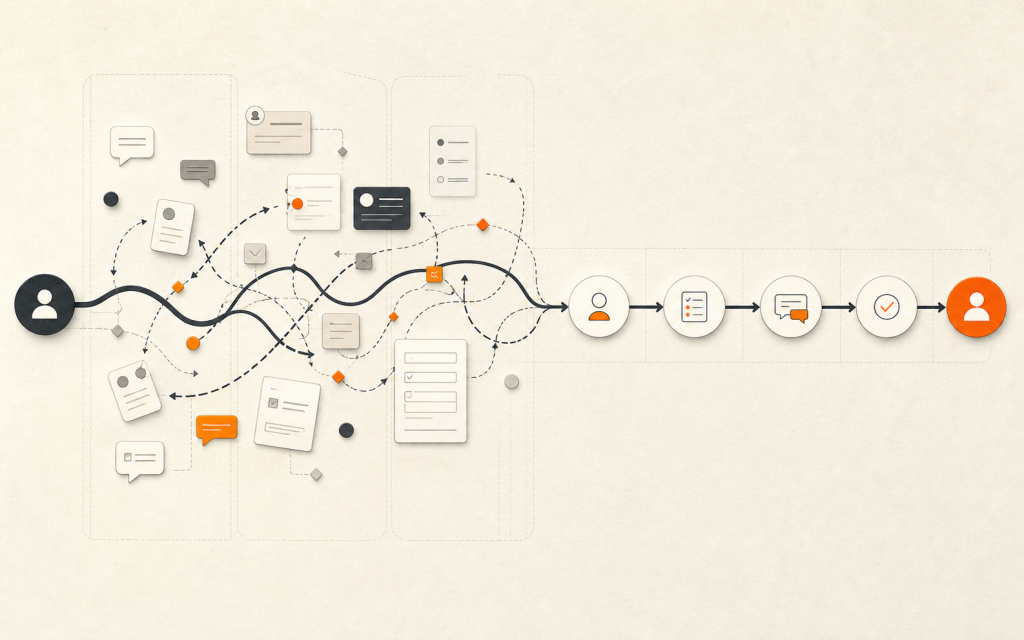
The brief is no longer a document that production receives after the important decisions have been made. It is becoming the control layer that tells the campaign what kind of demand is valuable, what message the brand can defend, what evidence the buyer needs, and what must happen after attention is earned.
Automation does not remove targeting. It changes where targeting happens.
In a highly manual campaign, marketers can feel that the audience is defined by the settings inside the advertising account.
In a more automated campaign, the platform also interprets the material surrounding those settings:
- Language used in the creative
- Problems described on the landing page
- Offers being promoted
- Conversion event being optimized
- Search terms, URLs, assets, and exclusions available to the system
- Quality of the feedback returned from the CRM or sales process
Google’s own documentation says AI Max can learn from keywords, creatives, and URLs to find additional relevant searches. It can customize text and, when enabled, choose a different landing page from the advertiser’s site. That is a meaningful operational change.
If the website contains vague positioning, the campaign is being asked to optimize with vague source material. If every service page speaks to a different market, the system inherits the confusion. If a form submission is treated as a success regardless of lead quality, the platform learns that quantity is the goal because that is what the business told it.
The machine is not sabotaging the strategy. It is following the evidence available to it with more enthusiasm than context.
This is why the brief matters. Someone still has to define what good means before the platform becomes efficient at pursuing it.
A targeting panel can select a company. It cannot understand the buying situation.
This distinction becomes more important in account-based marketing.
Account-based Marketing (ABM) is often reduced to a list of companies, a few senior job titles, and personalized creative that inserts the company name somewhere prominent. It looks targeted. Occasionally it even looks tasteful.
But an account is not an audience in the human sense. It is an organization containing people with different priorities, different risks, and different levels of influence.
LinkedIn’s B2B research describes buying groups as larger and more diverse, with marketers needing to create collective confidence across stakeholders. Its ABM guidance makes the same operational point: sales and marketing need alignment around who the decision-makers are, what problems they face, and what content they need at different stages.
A targeting panel can help a campaign reach people at the right company. It cannot decide why the operations lead should care now, what the finance stakeholder needs to believe, the risks concerning to the technical evaluator, what proof gives the internal champion credibility, and why the organization should change instead of doing nothing
Those are not media settings. They are strategic choices.
The campaign brief must hold them together before creative production begins. Otherwise, the account list is precise while the argument remains generic. That is not ABM. It is broad marketing wearing a name badge.
Creative is becoming part of audience definition
When platforms automate delivery, creative does more than persuade the audience after it is found. It helps the system understand where relevance may exist.
That makes generic creative more expensive than it appears.
An ad that says “Transform your business with innovative solutions” gives the platform, the buyer, and the sales team roughly the same amount of useful information: almost none.
A stronger message identifies a recognizable business situation.
For example:
“Your marketing team has campaign data in five systems, but nobody can connect it to account-level sales activity.”
That line is not perfect copy for every buyer. It is valuable because it contains a problem, an operating context, and the beginning of a qualification signal. The right reader can recognize herself or himself in it. The wrong reader can move on. Both outcomes are useful.
This is where creative judgment becomes more important, not less. Automated systems can produce and test variations quickly. They cannot rescue a proposition that refuses to choose a customer, a problem, or a point of view.
The future of creative strategy is not endless variation. It is disciplined variation around a clear commercial hypothesis.
The landing page is part of the targeting system
The campaign does not stop at the ad. Neither should the brief.
Google can use landing-page content and URLs as signals for matching and delivery. Buyers also use the destination to decide whether the ad’s promise survives contact with the company.
This creates a useful overlap between performance marketing, ABM, content strategy, UX, and web development.
If the ad speaks to a specific operational problem but the landing page returns to generic corporate language, the targeting was not precise. It merely delivered the right person to the wrong explanation.
If an ABM campaign addresses several members of a buying group, the destination needs enough structure for each stakeholder to find relevant evidence without turning the page into a departmental encyclopedia.
If the CTA asks for a sales conversation before the buyer has enough information to build internal confidence, the conversion path is asking the relationship to skip a few scenes.
We previously argued that a website is becoming source material for people and automated systems. The same logic applies here. Your site is not a neutral container waiting at the end of the media plan. Its structure, language, proof, and technical behavior are active campaign inputs.
The targeting panel may find the visitor. The experience determines whether the visitor believes the targeting made sense.
What a modern campaign brief needs to decide
A useful brief should not become a 47-slide presentation with a mood board, three stock photographs of collaboration, and no visible decision.
It should make the hard choices legible.
1. The business outcome
What should change if the campaign works?
Not merely impressions, clicks, or form submissions. Should a defined group of accounts enter active evaluation? Should existing demand move toward a specific service? Should a buying group understand a category differently? Should sales gain better-qualified conversations?
2. The buying situation
What is happening inside the target organization that makes the message relevant now?
Company size and industry are useful descriptors. They are not situations. A stalled implementation, fragmented workflow, regulatory deadline, new market entry, system replacement, or change in leadership creates context that firmographics alone cannot supply.
3. The buying group
Who experiences the problem, who evaluates the answer, who controls the budget, and who carries the risk?
ABM becomes more useful when the brief stops searching for one mythical decision-maker and maps the group that must reach confidence together.
4. The claim and the proof
What can the brand credibly promise, and what evidence supports it?
The creative team needs more than adjectives. It needs customer language, process evidence, product behavior, credible examples, constraints, and reasons to believe.
5. The boundaries
Who is not a fit? Which claims should not be made? Which pages should never receive campaign traffic? Which conversion events indicate activity but not value?
Automation needs direction, but it also needs fences. A system told only what to pursue will eventually find something technically compliant and strategically ridiculous.
6. The experience after the click
What must the landing page explain? Which proof belongs near the decision? What is the right next step for this level of intent? What information must pass into sales or the CRM?
This is where the brief becomes a digital-system document rather than a creative request.
7. The learning loop
What will the team review beyond platform-reported conversions?
Sales acceptance, account quality, buying-group engagement, pipeline movement, disqualification reasons, and customer language should influence the next campaign cycle. Otherwise, optimization becomes a closed conversation between the platform and its own dashboard.
Practical nugget: Before adjusting the audience settings, audit the inputs surrounding them. If the offer, creative, landing page, conversion event, and sales feedback describe five different versions of the customer, the targeting panel cannot create alignment for you.
AI can improve the brief without owning the strategy
AI has a useful role here, provided it is given work that benefits from speed rather than authority.
It can help a marketing team:
- Synthesize interview notes and sales-call themes
- Cluster recurring objections across accounts
- Compare a draft brief with landing-page language
- Produce controlled message variations from approved claims
- Identify missing evidence or conflicting assumptions
- Turn one strategic direction into channel-specific production drafts
That is meaningful productivity. It gives strategists and creative teams more time to examine the customer problem and improve the work.
But AI should not quietly invent the ideal customer, manufacture customer insight from thin data, or choose the commercial tradeoff the organization itself has avoided.
AI can help write the brief faster. It should not be allowed to make a weak brief look finished.
This balance also reflects the American Marketing Association’s 2026 outlook: automation may absorb more transactional marketing work, while human creativity, cultural fluency, trust, and authentic storytelling become stronger differentiators.
That is a positive development if teams use the saved time well.
Strategy is moving upstream, not disappearing
It is tempting to interpret advertising automation as a loss of marketing control.
Some manual controls are certainly becoming less central. That can feel uncomfortable, especially for practitioners who built real expertise inside them.
But clicking more switches was never the highest form of marketing judgment.
The harder work has always been deciding which market matters, what situation creates demand, which promise is defensible, how a buying group reaches confidence, and how the experience keeps the campaign’s promise.
Those decisions now need to be clearer because the systems executing them are faster, broader, and more willing to infer.
The brief is becoming more important than the targeting panel because the brief is where a company can still make its strategy explicit.
The panel distributes, but the brief decides what deserves distribution.
How Absolutmedia approaches it
At Absolutmedia, we treat campaign strategy as part of a connected digital system.
That means aligning the audience hypothesis, account priorities, buying-group needs, creative direction, landing-page experience, content structure, conversion workflow, CRM handoff, and measurement plan before asking automation to scale the result.
Sometimes the work is a sharper brief and message system. Sometimes it requires new landing pages, a clearer website structure, an interactive tool, a content workflow, or better routing between marketing and sales. Often, the visible campaign problem is evidence of a disconnected operating system behind it.
Our method starts by framing the business decision and the customer situation. Then we prototype the message and experience, build the necessary digital components, and create a feedback loop the team can actually use.
Automation works better when the strategy around it is legible. So do people.
Next step
Take one active campaign and review it without opening the targeting panel.
Can the team state the buying situation, the buying group, the central claim, the proof, the disqualifiers, the post-click experience, and the signal that would indicate genuine business value?
If those answers are scattered across a deck, an ad account, a salesperson’s memory, and three versions of the website, start there.
The next improvement may not be another audience adjustment. It may be a better shared definition of who the campaign is for and what the whole system should help that buyer do next.
AI usage note: This article was written with human editorial direction and review. AI tools were used in a low-risk support role for research, drafting assistance, language refinement, and structure checks. The final argument, examples, editorial judgment, and publishing decisions remain human-led.