There is a distinction in AI that many businesses still have not fully confronted.
AI can reproduce value, or it can produce value.
It can reproduce value by generating more of what already exists: more articles, more visuals, more summaries, more proposals, more code, more reports, more responses. Faster, cheaper, and at scale. That is useful. In some cases, very useful.
But AI can also produce value in a deeper sense. It can help a business operate with better judgment, stronger systems, faster learning loops, cleaner service delivery, and more leverage per person. It can expand capability, not just output.
That distinction matters because a lot of AI output today feels generic, not because the models are incapable of depth, but because people approach them with shallow intent.
The tools are powerful. The usage is often not.
And the market has a lot to do with that. Speed sells. Volume sells. Cheap production scales. Generic output is often easier to approve, easier to ship, and easier to justify in the short term than deliberate work that requires strategy, judgment, and iteration. So the path of least resistance wins. Not because it is the best use of AI, but because it is the easiest one to operationalize.
That is why this conversation is not really about whether AI is good or bad. It is about what kind of value people are choosing to create with it.
The easy win is reproduction
Most organizations begin with the obvious uses.
They use AI to draft marketing copy, summarize meetings, generate first-pass designs, write outreach emails, clean up notes, answer routine questions, or speed up support work. None of that is trivial. In many teams, these use cases save real time and reduce friction.
McKinsey’s 2025 State of AI findings reinforce that point: efficiency remains one of the most common objectives in enterprise AI adoption. But the same research also shows that the companies seeing the strongest results are less likely to stop at efficiency alone. They are more likely to connect AI to growth, innovation, and workflow redesign, not just faster execution.
That is the first major divide. Using AI to reproduce value usually means accelerating existing output. Using AI to produce value means changing the quality of execution, the structure of the workflow, or the capability of the business itself.
One makes the machine run faster. The other changes what the machine can actually do.
Why slop keeps winning
This is where the conversation gets uncomfortable, but also more honest.
AI has been trained on massive amounts of human work: writing, visual language, reasoning patterns, technical knowledge, business communication, design conventions, and accumulated problem-solving. In that sense, these systems carry compressed human knowledge inside them.
And yet, one of the most common uses of that inherited intelligence is to produce generic solutions with minimal intent.
AI slop is usually not a model problem first. It is an intent problem.
Many teams are using borrowed intelligence to mass-produce borrowed ideas.
That sounds harsh, but it is not an anti-AI argument. It is a misuse argument. The issue is not that the model contains patterns learned from human work. The issue is that many people use that inherited intelligence to avoid the deeper human work of judgment, strategy, taste, and responsibility.
The market encourages that behavior.
If a company is rewarded for shipping more content, faster replies, lower production costs, and visible output volume, then the easiest application of AI becomes the most attractive. Reproduction wins because it is immediate. Production, in the deeper sense of creating new value, requires more discipline. It needs a point of view. It needs workflow design. It needs curation. It needs people willing to ask whether the output is actually useful, differentiating, and connected to a business outcome.
That is harder work. And that is exactly why it matters.
Practical nugget: If an AI initiative mainly increases volume, ask one more question before calling it successful: what capability, decision, or business constraint has actually improved because of it? That question forces a shift from novelty to leverage.
Reproducing value is not the same as creating it
This is where many AI strategies quietly collapse.
A team sees time savings and assumes value creation. A company sees content velocity and assumes progress. A founder sees more output and assumes the business is becoming more capable.
Sometimes it is. Often it is not.
BCG’s 2026 AI at Work research makes this tension clearer. AI adoption is rising quickly, and many workers report meaningful time savings. But BCG’s central warning is that time saved does not automatically become business value. Strategy matters more than tools. Organizations that give people access to AI without redesigning work around it often capture only a fraction of the upside.
That is a critical point, because productivity gains are real, but productivity is not the final metric. If time is saved and then scattered, interrupted, or consumed by the same low-quality process, the organization becomes more efficient without becoming more valuable.
That is why reproducing value and producing value should not be treated as interchangeable.
Reproducing value often looks like this: AI helps create more assets, faster drafts, quicker summaries, cheaper content, or broader communication output.
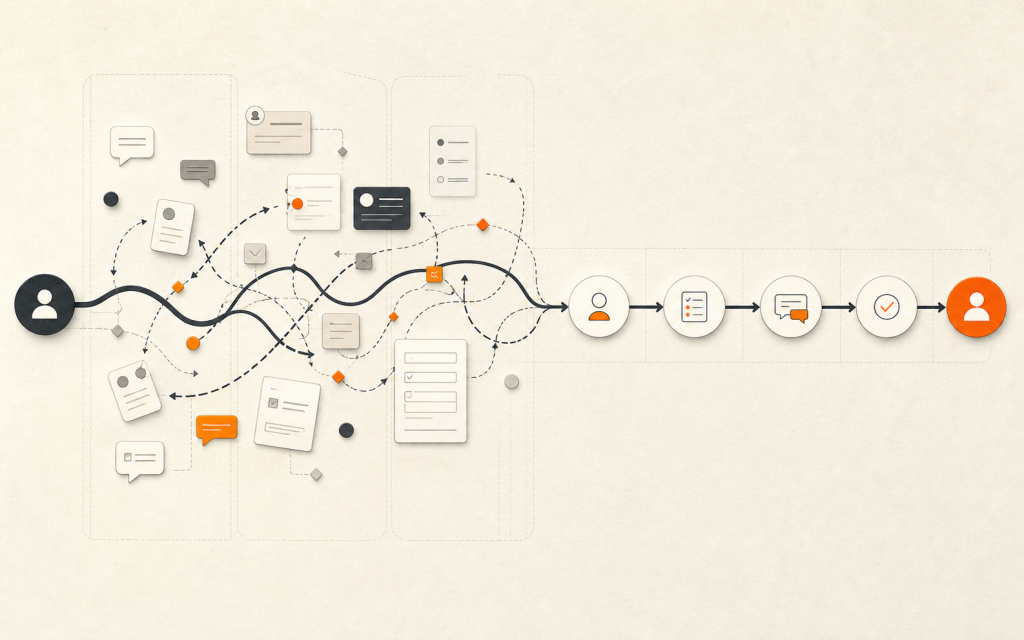
Producing value looks different: AI helps restructure intake, improve routing, support better analysis, surface knowledge at the right moment, reduce decision lag, strengthen service delivery, or allow a smaller team to perform at a higher level than before.
One is mostly acceleration. The other is expanded capability.
What the industry evidence is actually telling us
A useful way to test this thesis is to look at where serious organizations are finding results.
The strongest AI outcomes are not coming from efficiency alone. McKinsey’s 2025 research suggests that the higher-performing organizations are more likely to combine cost goals with growth and innovation goals, and they are more likely to redesign workflows as part of adoption. That supports a simple conclusion: AI becomes more valuable when it changes how work gets done, not when it only speeds up isolated tasks.
BCG’s 2026 research adds another layer. Its findings show strong usage, visible time savings, and increasing familiarity with AI tools across the workforce. But it also highlights that strategic clarity matters more than tool access. In practical terms, that means saved time does not become enterprise value unless the organization has a clear idea of what that freed capacity is for.
Even Microsoft, which has had inconsistencies in its approach to AI, pushes the argument further. According to Microsoft’s 2026 Work Trend Index, its framing is not just that AI helps people work faster but that it can expand human agency and enable more people to perform work that previously required narrower expertise, more time, or more support. That is much closer to capability expansion than simple automation.
Consulting firms such as Deloitte are recognizing that even AI adoption is moving quickly, but organizations are still struggling to bridge the gap between technical capability and scalable business impact. In other words, the technology is ahead of the operating model in many cases. That supports the same thesis from another angle: AI value does not come from having access to the model. It comes from building the organizational conditions that allow the model to create usable outcomes. Read the study “Deloitte’s Enterprise Reporting” to understand how AI initiatives are being tackled by this dominant player in the consulting space.
Taken together, these studies point in the same direction: AI improves productivity.
Productivity alone does not equal strategic value. Strategic value appears when AI changes workflow, capability, and execution quality.
That is the real line separating reproduction from production.
The system around the model is where value is decided
This is why so many AI implementations look impressive in a demo and underperform in the real business.
The model can generate. That was never the hard part.
The hard part is deciding what the generation is for, where it enters the workflow, who reviews it, what standard it must meet, what decision it improves, what operational bottleneck it removes, and how the organization captures the upside.
Without that, the business gets more output but not more trust.
Without that, AI becomes a volume machine.
With that, AI can become a capability layer.
That capability layer may not always be visible to customers at first. In many cases, the best uses of AI begin behind the scenes: intake systems, research workflows, service operations, knowledge retrieval, review processes, structured handoffs, internal copilots, or decision support. These are not always flashy use cases, but they are often the ones that make the business tangibly better.
And that is what value creation usually looks like in practice. Not spectacle. Not novelty. Better operating reality.
The real choice is not technical
The real choice organizations face is not whether AI can generate content, code, or output. It clearly can. The real choice is whether they will use AI to amplify commodity production or human judgment.
Will they use it to flood markets with generic material because that is faster and easier? Or will they use it with enough strategic intent to improve decisions, sharpen service models, redesign execution, and create a level of capability that did not exist before?
AI can do both.
It can produce slop and it can produce leverage. The difference is usually the quality of intent behind the system using it.
How Absolutmedia approaches it
At Absolutmedia, we do not begin with the tool. We begin with the workflow.
That means looking closely at how requests enter the business, where decisions slow down, where knowledge gets trapped, where handoffs fail, where teams repeat work, and where execution quality depends too heavily on overloaded people. From there, we identify whether AI should automate, support, structure, or extend the process.
That is also why we treat human-in-the-loop review as part of the design, not as an afterthought. Good AI implementation is rarely about removing human judgment completely. It is about placing human judgment where it creates the most value and using AI deliberately around it.
If you want to explore related thinking, a few useful starting points are AI Automation for Business Workflows: Where to Start Without Overbuilding, Scalable AI Operations: From Opportunity Discovery to Repeatable Business Systems, and How to Build an AI-Enabled Digital System Without Losing Human Control.
Next step
If your team is already using AI, the next step is probably not adding another tool.
It is identifying where AI is merely reproducing output and where it could genuinely improve capability, decision quality, service delivery, or workflow performance. That is where strategic value starts to appear.
If you want to map that more deliberately, Absolutmedia’s AI services are built around workflow diagnosis, operational redesign, and practical implementation rather than generic automation theater.