There is a strange little theater happening around AI-assisted writing.
Someone uses AI to draft an article, and suddenly the room fills with defenders of literary purity. The eyebrow rises. The moral concern arrives. People begin speaking as if every sentence must be handcrafted in silence with a fountain pen, a troubled soul, and no browser tabs open.
Then the same people open LinkedIn, rewrite their profile with a prompt, let Grammarly smooth their emails, use QuillBot to rephrase a paragraph, accept predictive text on their phone, and send a “polished” message that sounds like it spent a weekend at a personal branding retreat.
Apparently, AI is unacceptable when it admits its name.
The stigma is not really about whether artificial intelligence helped shape the sentence. AI-assisted communication is already normal. Grammarly describes its AI tools as support for clearer, faster, more impactful communication. Quillbot positions its tools around paraphrasing, grammar checking, fluency, tone, summarizing, and other writing support. LinkedIn’s own job-seeker guidance recommends using AI to rewrite profile headlines, About sections, resumes, and cover letters so a candidate’s skills and accomplishments are clearer.
So the real question is not whether AI touched the text.
The better question is: did the tool help clarify the human behind the text, or did it help invent one?
Professional polish was never innocent
AI did not invent professional embellishment. It only made the machinery more visible.
People have always polished resumes, rewritten bios, borrowed templates, hired resume writers, asked friends to “make this sound better,” and converted plain experience into the polished dialect of employability. We have entire industries built around making normal professional lives sound like decisive leadership journeys.
Sometimes that polish is useful. A person may have real experience but weak language. They may be qualified but not good at selling themselves. They may understand the work but struggle to describe it in a way recruiters, clients, or decision-makers can scan quickly.
That is not fraud. That is translation. The problem starts when translation becomes costume.
There is a difference between “managed client communication during implementation” and “led cross-functional transformation initiatives across complex stakeholder ecosystems” when the actual job was forwarding status updates and hoping nobody replied all.
AI did not create that gap. It only gave more people a faster way to fall into it.
A real example: polish the CV, not the person
Recently, I was advising a friend who was trying to improve his chances of getting a better job. My recommendation was simple: use AI to polish the CV, but do not use it to invent a different person.
Let the tool help organize the experience. Let it sharpen weak phrasing, remove clutter, bring structure to the profile, and make the value clearer. But every skill, every project, every responsibility, and every result still has to be something he can stand behind in an interview.
Not only for ethical and legal reasons, although those matter. For trust.
Trust is very hard to rebuild once it is damaged. A good CV should make real experience easier to understand. It should not create a version of you that collapses the moment someone asks a second question.
That is the line. AI can help someone express competence. It should not manufacture competence.
The useful distinction: mirror, mask, or substitute
This is where the AI conversation becomes more practical and less theatrical.
There are at least three ways to use AI in writing:
AI as a mirror helps you express what you already know. It organizes, clarifies, trims, translates, and makes the thinking easier to read.
AI as a mask makes you appear more experienced, strategic, fluent, or informed than you really are. It gives a surface of competence without the substance underneath.
AI as a substitute replaces thinking altogether. The person does not bring a point of view, evidence, experience, or judgment. They bring a prompt, receive a plausible object, and publish it with the confidence of someone who has confused output with authorship.
The first use is normal and often valuable. The second is risky. The third is how AI slop enters the bloodstream of the internet and makes everyone more tired.
Practical nugget: Before judging AI-assisted work, ask whether the tool helped reveal the person’s thinking, hide the limits of that thinking, or replace the thinking entirely.
That distinction is more useful than asking whether AI was used. Of course AI was used. It is in the keyboard, the browser, the email client, the resume optimizer, the document editor, the support desk, the social scheduler, and the quiet little “improve this” button that now appears everywhere like a tiny consultant with no invoice.
The tool is not the scandal. The absence of human ownership is.
Disclosure is useful, but it is not a substitute for judgment
I still believe AI-assisted content should often be labeled, especially when it matters to trust, authorship, accuracy, or brand voice. Mature brands should not need a court order to be transparent. That was the point behind our previous article, Most AI Content Should Be Labeled.
But disclosure alone does not tell us whether the work is good.
“Written with AI” can describe a thoughtful article shaped by a person with a clear argument, real experience, careful editing, and responsible review.
It can also describe a bland soup of scraped consensus with a title that sounds like it was assembled during a networking breakfast.
The label is a signal. It is not a verdict.
This is the uncomfortable part of the debate: many people want disclosure to do the work of taste. They want the label to tell them whether the thing deserves attention. But quality still requires reading. Trust still requires context. Responsibility still belongs to the person or organization putting the work into the world.
That is true for an article. It is true for a resume. It is true for a LinkedIn profile. It is true for a client proposal. It is true for a sales email that has been “enhanced” until it sounds like it went to business school against its will.
The hypocrisy is not using AI. The hypocrisy is pretending not to.
The most honest position is not anti-AI or pro-AI. Those labels are getting stale.
The honest position is: we should judge AI-assisted work by authorship, accuracy, taste, intent, and accountability.
Did a person bring the insight?
Can they defend the claim?
Does the work represent real experience?
Was the tool used to clarify or deceive?
Was the output reviewed by someone with enough judgment to catch nonsense before it escaped?
These are better questions than “Was AI involved?” because that question is becoming almost meaningless. AI is already involved in the daily mechanics of communication. People use it to write faster, sound clearer, remove friction, adapt tone, summarize meetings, prepare drafts, and survive the endless admin layer of modern work.
There is nothing automatically shameful about that.
But there is something shameful about using a tool to project expertise you do not have, judgment you did not apply, or care you never invested.
Taste is the missing layer
A lot of the resentment toward AI content is really resentment toward bad taste.
People are tired of articles that say nothing with great confidence. Tired of “game-changing” insights that change no games. Tired of empty thought leadership wearing a blazer. Tired of content that has the texture of a hotel lobby: clean, neutral, and impossible to remember.
AI gets blamed because AI makes that kind of content easier to produce. Fair enough. But the deeper problem is not the tool. It is the editorial standard around the tool.
A good writer can use AI and still produce work with judgment, specificity, restraint, and point of view. A lazy operator can use the same tool to flood a website with synthetic fog.
That difference is not technical. It is cultural.
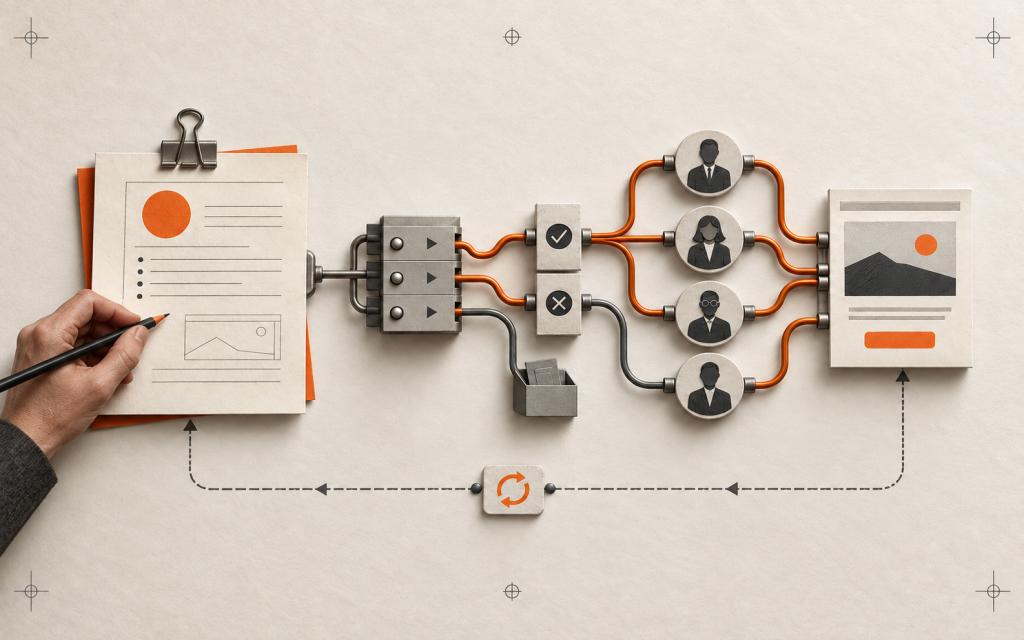
Companies adopting AI need more than prompts. They need standards. They need review points. They need a point of view about what deserves to be published, sent, automated, or approved. This connects directly to the way AI-enabled systems should be designed with human control: with visible review points, workflow logic, and responsibility built around the tool instead of hidden behind it.
AI does not absolve anyone from authorship. It only makes authorship harder to fake for very long.
How Absolutmedia approaches it
At Absolutmedia, we treat AI as a practical support layer, not a personality replacement.
In content, strategy, automation, and digital systems, the human role remains central: define the intent, shape the argument, verify the claims, review the output, and decide what is good enough to represent the brand. AI can accelerate research, structure, drafting, summarization, comparison, and workflow support, but it should not erase accountability.
That is the same principle behind our AI automation and AI consulting work. We start with the real workflow, define the human review points, and design AI support around the places where it creates useful leverage without pretending the tool owns the judgment.
The goal is not to make everything sound more artificial. The goal is to help people and teams communicate, decide, and execute with more clarity.
Next step
If your team is using AI informally already, stop pretending the question is whether AI belongs in the work. It is already there.
The better next step is to define where it is useful, where it is risky, what requires human review, and what standards decide whether the output is good enough to publish, send, automate, or put in front of a client.
Start with one real workflow: a proposal, a support response, a profile update, a content draft, an internal summary, or a recurring decision. Then ask what the AI is doing there: mirror, mask, or substitute.
That answer will tell you far more than the label.
AI usage note: This article was written with human editorial direction and review. AI tools were used in a low-risk support role for research, translation, drafting assistance, language refinement, and structure checks. The final argument, examples, editorial judgment, and publishing decisions remain human-led.