If you want to understand frontier AI as a market instead of as a stream of product announcements, the old life cycle curve is still useful.
It is not perfect. No market moves in a clean arc, and AI is unusually tangled because research, infrastructure, consumer products, enterprise software, and geopolitics are all colliding at once. But the curve still helps because it forces a more practical question: where exactly are we on it, and what changes once the noise of novelty starts turning into a real competitive structure?
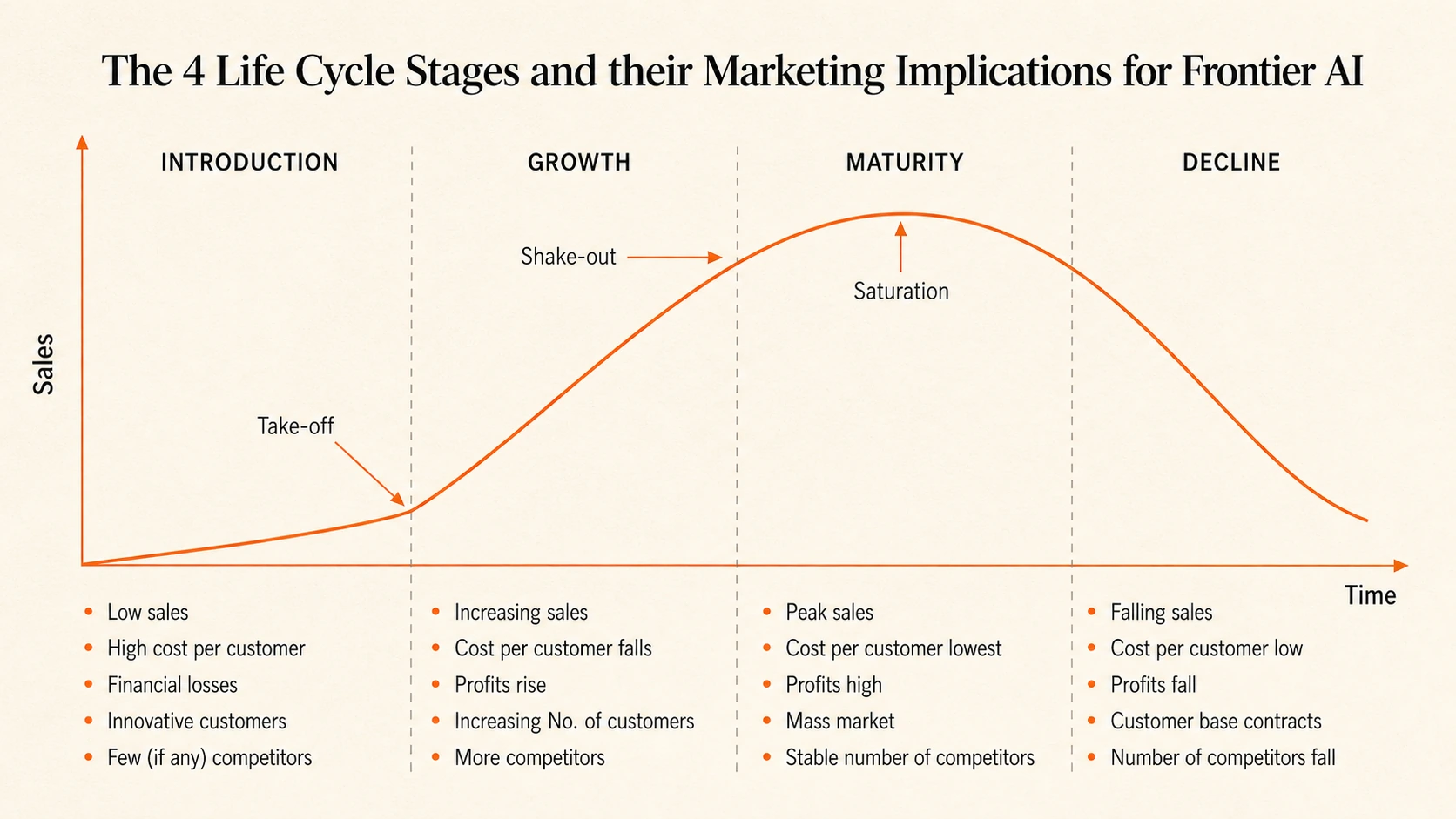
My read, as of July 3, 2026, is that frontier AI has already cleared the introduction phase and is now in the early growth stage. That matters because the strategic question has changed. The question is no longer whether AI is real. The question is where durable value will remain once the field gets crowded, performance gaps narrow, and pricing pressure starts doing what pricing pressure always does.
For anyone building, buying, or advising around AI, that is the more useful lens.
Introduction
The introduction stage of frontier AI ran roughly from 2018 through late 2022. The technical progress was already serious, but the market was still narrow. Sales were low by comparison to what came later. The cost per customer was high because everything underneath the experience was expensive: compute, talent, training, inference, and experimentation. Financial losses were normal because most of the companies involved were spending ahead of the market rather than harvesting it.
The customer base in that phase was also very specific. These were not mass-market users. They were innovative customers in the literal sense: researchers, technical teams, well-funded startups, advanced enterprise labs, and a small circle of operators willing to test incomplete systems because they believed the capability curve would matter later.
Competition existed, but it was still concentrated among relatively few serious players. OpenAI was already becoming the commercial reference point. Google DeepMind had the research depth and infrastructure. Anthropic entered with a safety-forward and enterprise-trust posture. Meta was influential through research and open releases. A few other labs mattered, but this was not yet a crowded market in any commercial sense.
This is also why the introduction stage felt expensive and intellectually exciting at the same time. What was being built was clearly important, but it was not yet operationally normal. The market could see the capability, but it had not yet solved distribution, trust, or habit at scale.
That framing lines up with the broader shift documented in the Stanford HAI 2025 AI Index, which showed industry rapidly taking over the frontier and noted that nearly 90% of notable AI models in 2024 came from industry, while the frontier itself was getting more crowded and more competitive.
Take-off
If we need one date for take-off, the strongest consensus answer is November 30, 2022, when OpenAI released ChatGPT to the public. That does not mean the entire take-off happened in a day. It means the market finally had a moment that compressed years of technical progress into one product that ordinary people could use immediately.
OpenAI’s own usage research is useful here because it anchors the scale of that transition. In its paper on how people are using ChatGPT, OpenAI notes that ChatGPT launched in November 2022 and had reached 700 million weekly active users by July 2025. In a separate OpenAI business report on ChatGPT adoption patterns at work, the company says that within months it had reached 100 million weekly active users, which is exactly the kind of velocity that turns a technical category into a market event.
So the better way to date take-off is as a window: November 2022 through 2024.
That was the period when four things happened at once. Public awareness exploded. Enterprise urgency spiked. Investment accelerated. And a fast copycat market formed around assistants, wrappers, model APIs, infrastructure tools, safety layers, benchmarking, and distribution bets. Once that happened, frontier AI stopped being a niche technical discussion and became a mainstream commercial race.
Growth
This is where we are now, and we are still early in it.
The signs are the classic ones, even if the mechanics are new. Sales are increasing. The cost per customer is falling as model access gets bundled, subsidized, optimized, and distributed through larger platforms. Profits are rising for the leaders, even if the category as a whole still burns extraordinary amounts of capital. The number of customers keeps expanding from individual users to enterprise teams to entire operational workflows. And the field is filling up with more competitors, more products, and more variations of the same promise.
The current growth signal is not just hype. It is visible in adoption. The Stanford HAI 2026 AI Index reports that generative AI reached 53% population-level adoption within three years of its mass-market introduction, faster than the PC or the internet over comparable periods. The same report says organizational adoption reached 88%, and that more than 90% of notable frontier models in 2025 came from industry. That is not an introduction-stage pattern. That is a growth-stage pattern.
It is also visible in the tightening competitive field. Stanford’s 2025 AI Index noted that the score difference between the top and 10th-ranked models fell from 11.9% to 5.4% in a year and that the top two were separated by just 0.7%. When a market looks like that, the winners cannot rely on a huge raw-capability lead forever. They have to win through distribution, trust, workflow fit, ecosystem position, and capital endurance.
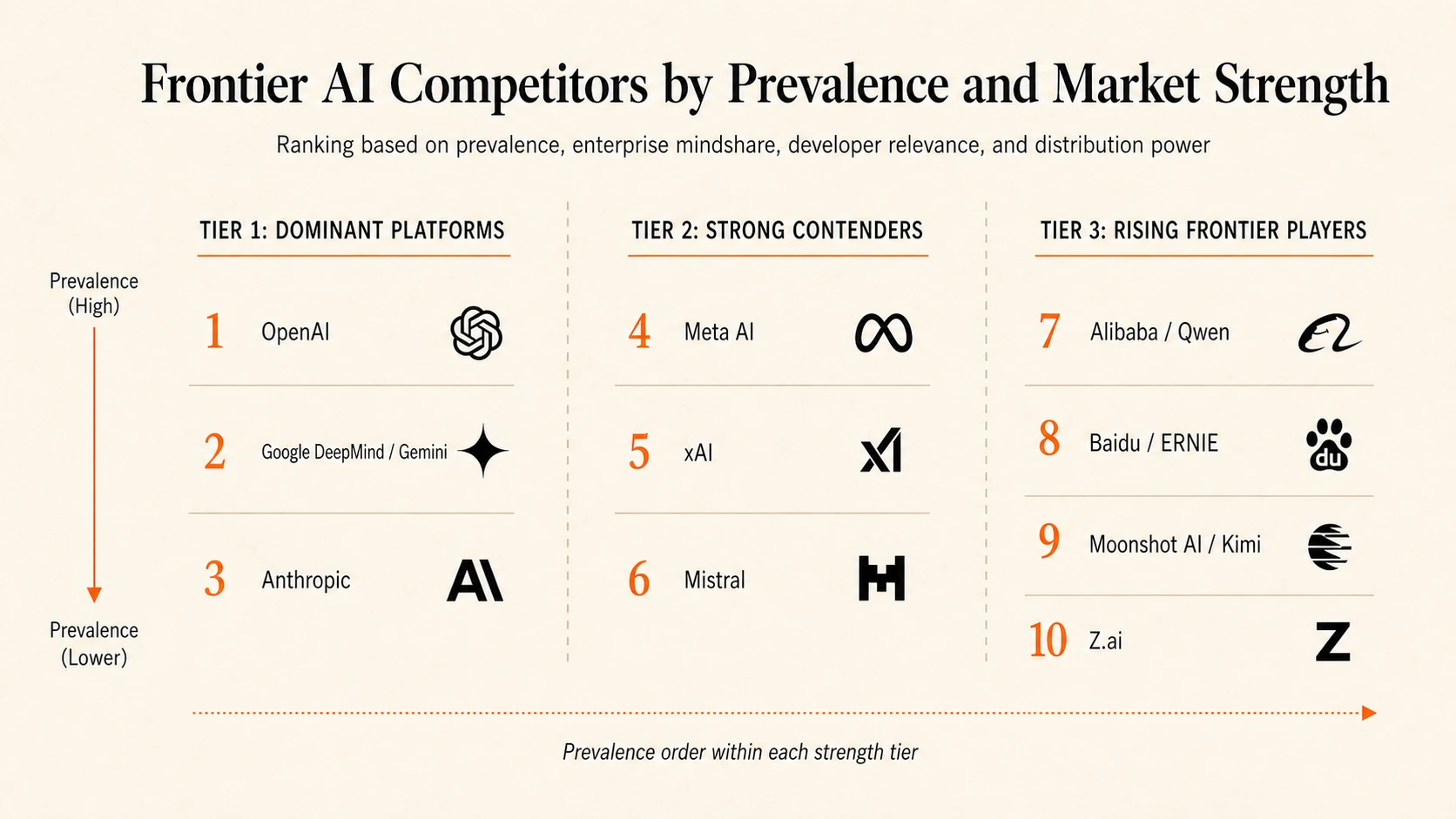
That ranking is an editorial inference, not a universal leaderboard. I am weighting public usage, enterprise mindshare, developer relevance, and distribution power more heavily than one-off benchmark wins.
OpenAI remains first because it still has the strongest combination of consumer familiarity, enterprise spillover, and habit formation. ChatGPT became the default starting point for a huge share of the public market, and that matters because consumer familiarity shortens enterprise adoption cycles.
Google DeepMind is second because distribution still matters more than many model watchers want to admit. Gemini is no longer only a lab story. It is wired into search, productivity, mobile, and Google’s broader product surface. Google’s own history of Gemini shows the model first surfaced publicly at I/O 2023, and by the following year it had already been pushed through Search, Ads, Workspace, Pixel, and more in a way only Google can do at scale. See how Google describes Gemini’s rollout.
Anthropic sits third, but with disproportionate influence relative to its public visibility. Claude has become one of the strongest enterprise and developer-reference models in the market, especially where reliability, writing quality, and coding trust matter. That arc goes back to Anthropic’s original launch of Claude in March 2023, but its current position comes more from execution than from launch timing.
Meta, xAI, and Mistral each represent a different growth-stage strategy. Meta uses open distribution and ecosystem gravity. xAI uses visibility, consumer attention, and platform adjacency. Mistral plays the European sovereignty and flexible deployment angle with unusual discipline.
The next tier matters more than many Western market summaries suggest. Stanford HAI’s issue brief on China’s diverse open-weight AI ecosystem argues that Chinese labs are not just participating; they are catching up fast enough to matter at the frontier. The brief notes that as of December 4, 2025, top closed models from Google DeepMind, xAI, OpenAI, and Anthropic were only marginally ahead of the best systems from Z.ai, Moonshot AI, Alibaba, and Baidu, with results close enough on Chatbot Arena to be listed as tied for first place. Even if you treat that benchmark with caution, the larger point stands: frontier AI is now a global race, not a U.S. monologue.
Once a market enters growth, the strategic question is no longer who can launch first. It is who can keep value when performance gaps narrow and pricing pressure begins.
Practical nugget: If your team is evaluating AI vendors right now, do not treat frontier-model rankings as a buying decision by themselves. Use them as context, then evaluate which provider actually fits your workflow, governance needs, integration surface, review model, and total operating risk.
Shake-out
The next milestone on the curve is not maturity. It is shake-out.
My estimate is that the frontier AI market enters that phase around 2027 to 2028.
That is the point where the category’s confidence starts running into a harder economic structure. Too many products will be too similar. Too many assistants will still be wrappers with better branding than differentiation. Too many buyers will realize that impressive demos do not automatically become defendable workflows. And too many companies will still be paying for compute and distribution as if market excitement were the same thing as durable margin.
This is where the field should start thinning.
The casualties will not be limited to small startups. Some will be weak application-layer companies. Some will be overvalued model challengers. Some will be tool vendors that never solved for trust, review, governance, or real integration. Some will simply discover that once the frontier gets tighter, “we also have an assistant” is not a company category.
Regulation will matter here. So will procurement discipline. So will the basic fact that enterprises eventually ask harder questions than consumers do. They ask who owns the output, who reviews it, what happens when it is wrong, and how much of the workflow can actually change without increasing risk.
That is why shake-out should be read less as a panic event and more as the market’s first serious correction toward operational reality.
Maturity
The maturity stage is where frontier AI stops feeling like a special event and starts behaving like infrastructure.
I would place the early emergence of maturity around 2028 to 2030, with Saturation most likely around 2029 to 2031.
That is when the category reaches something closer to peak sales at the market level, customer acquisition becomes cheaper and more standardized, profits are strongest for the winners, the market becomes genuinely massive, and the number of serious competitors stabilizes because the field finally knows who belongs in the top tier and who does not.
This does not mean innovation stops. It means the emotional temperature changes.
At maturity, the frontier model itself matters less as a spectacle. What matters more is where the intelligence lives inside real systems. Search, operating systems, browsers, productivity suites, development environments, customer operations, research tools, media workflows, and domain-specific business software all become normal containers for frontier capability. The product is no longer “AI” in the abstract. The product is the system that now works differently because AI became native to it.
That also tends to be the phase where cost per customer is lowest in practical terms. Platform companies have already done the bundling. Infrastructure is more optimized. Customer familiarity is no longer something you have to manufacture. And the dominant firms are finally harvesting the advantage they spent the growth years buying.
In other words, maturity will likely be the most useful phase for customers and the least romantic phase for commentators.
AI Bubble Burst
This is the part many people confuse.
An AI bubble burst can happen near the maturity peak without proving that AI itself was overhyped in the deeper sense. Markets regularly overprice the future before the future becomes operationally ordinary. That is not a sign that the technology disappears; it is a sign that capital got ahead of structure.
My expectation is that some version of an AI bubble reset will cluster around the maturity window, not before the market proves itself. By then, the problem will not be lack of demand. The problem will be repricing. Too many companies will have been valued as if they owned a permanent moat when what they really owned was a temporary lead, a good interface, a distribution partnership, or a short-lived performance edge.
That is why the eventual reset should be read more like the internet’s consolidation than like a technological collapse.
The internet did not fail. The speculative excess around it was repriced. A few dominant layers remained. Infrastructure became indispensable. Distribution concentrated. Many companies disappeared, got acquired, or became features inside larger platforms. The same logic is likely to show up in frontier AI.
What bursts is not the utility of AI. What bursts is the belief that every layer around AI deserves frontier-era multiples forever.
That distinction matters because it changes how you build. If you are building for the bubble, you optimize for velocity, narrative, and attention. If you are building for the post-bubble market, you optimize for workflow ownership, switching costs, trust, integration, and economic durability.
The AI bubble burst will probably be narrated like a cataclysm because markets are always louder when they are repricing than when they are building. Headlines will frame it as collapse. Investors will call it a correction. Founders will call it irrational. But in the context of frontier AI, the more accurate word is purge.
A purge removes the excess that accumulated during the growth frenzy: inflated valuations, weak wrappers, indistinguishable copilots, and business models that depended more on excitement than on durable operational value. What disappears is not AI’s usefulness. What disappears is the fantasy that every company touching AI deserves permanent frontier-level attention, margin, and market power.
That is why this phase should be read less as an extinction event and more as a brutal sorting mechanism. The strongest platforms, infrastructure providers, and workflow-native products will not vanish. They will become even more central because the market will finally stop rewarding mere presence and start rewarding real embedment, trust, and economic discipline.
In that sense, the burst will resemble the internet’s consolidation cycle more than a technological death. The noise will fall away, the speculative layers will thin out, and what remains will be the businesses that built something people actually need inside systems they cannot easily replace.
Decline
The word “decline” sounds more dramatic than it probably needs to be.
In frontier AI, decline should not be understood as social abandonment or technical irrelevance. It should be understood as market consolidation.
The earliest version of that phase probably begins after 2030, although the timing will depend on regulation, hardware concentration, energy economics, and how much of the value pool stays in models versus shifting into distribution, enterprise workflow, and embedded product layers.
At that point, sales growth at the category level may start falling even while AI remains everywhere. Cost per customer stays low because the market is already educated. Profits fall for weaker players because the field is more standardized, more price-sensitive, and less forgiving. The customer base contracts in some subcategories because generic assistants, undifferentiated wrappers, and overpriced standalone copilots stop feeling necessary. And the number of competitors drops because many of them either disappear or get absorbed.
That is why decline will likely feel more like normalization than collapse.
Some AI segments will hit that reality sooner than others. Generic chat interfaces are vulnerable. Thin wrappers are vulnerable. Standalone copilots with weak workflow ownership are vulnerable. The companies most likely to survive are the ones that stop behaving like temporary AI products and start behaving like durable infrastructure, trusted workflow layers, or deeply embedded platforms.
By that stage, the winners may not even be described primarily as “AI companies.” They will just be the companies that own important systems, and AI will be one of the reasons those systems are hard to replace.
Lessons from History: Navigating the Frontier
History teaches us that technological revolutions are rarely linear; they are characterized by waves of invention, hype, and eventual structural consolidation. Like the industrial and internet revolutions before it, the frontier AI transition is fundamentally an engine of progress, holding the potential to become a massive net benefit to society by unlocking new levels of human productivity and problem-solving.
Yet, the path to maturity is not automatic. To realize these benefits, we must remain disciplined, keeping AI development in bounds for both ethical and economic reasons. This means moving beyond the “frontier” mindset to prioritize safety, verifiable trust, and sustainable economic integration. By anchoring AI in real-world utility and sound oversight, we ensure that this technology serves as a foundation for growth rather than a source of volatility, ultimately strengthening the systems we rely on every day.
How Absolutmedia approaches it
At Absolutmedia, this is why we do not treat AI as a decoration layer. We look at the operating model first.
The useful question for a client is rarely “which model is best this week?” The better question is where intelligence belongs inside the workflow, where human review still matters, and how to design the system so the business gains speed without losing responsibility.
That is the same logic behind Absolutmedia’s view of AI consulting and AI automation: map the operation, define the review points, then build the interface, automation, or decision layer around trust. It is also why our process stays grounded in defining, prototyping, building, and launching connected systems instead of shipping disconnected AI features.
Next step
If your team is trying to decide where frontier AI fits in your business, the next useful move is not to chase every model update. It is to identify one workflow where better speed, judgment support, retrieval, summarization, routing, or review would create a measurable advantage, then design the human control points before you scale the automation.
That is usually where the real value begins: not at the frontier benchmark, but at the point where the technology becomes operationally trustworthy. If you want a practical starting point, read Scalable AI Operations: From Opportunity Discovery to Repeatable Business Systems alongside our AI Consulting lane.
Sources
- Stanford HAI 2026 AI Index Report
- Stanford HAI 2025 AI Index Report
- OpenAI: How people are using ChatGPT
- OpenAI: ChatGPT usage and adoption patterns at work
- Anthropic: Introducing Claude
- Google: How Gemini got its name
- Stanford HAI: China’s Diverse Open-Weight AI Ecosystem and Its Policy Implications