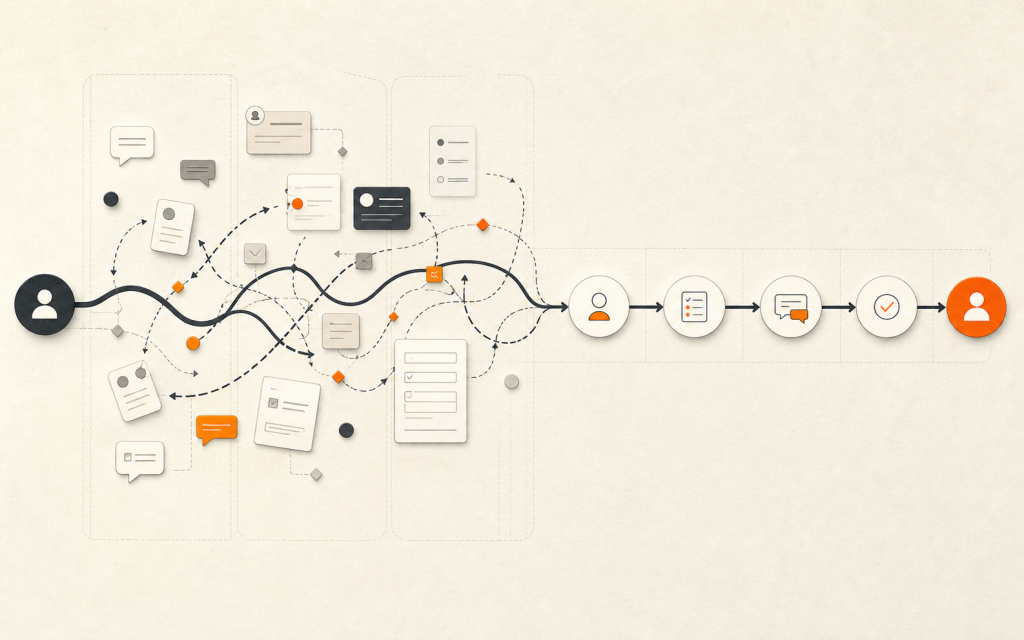
If you spend any time around modern software, the pattern is hard to miss. Release notes are fuller. Product updates arrive closer together. Features that used to take a quarter now show up between one Monday and the next coffee refill.
This is not just a collective hallucination caused by too much LinkedIn and too little sleep.
The public update trails are unusually busy. OpenAI’s Codex changelog shows 70 unique update dates between January 14, 2026 and July 16, 2026. From June 1 to July 16, 2026, Codex posted updates on 19 out of 46 calendar days, which means users saw visible updates on about 41% of days in that stretch. Cursor’s changelog shows 5 releases in 23 days between June 18, 2026 and July 10, 2026, including updates on back-to-back days, June 29 and June 30. GitHub Copilot’s July 2026 changelog alone shows updates landing on July 7, 8, 9, 10, and 14.
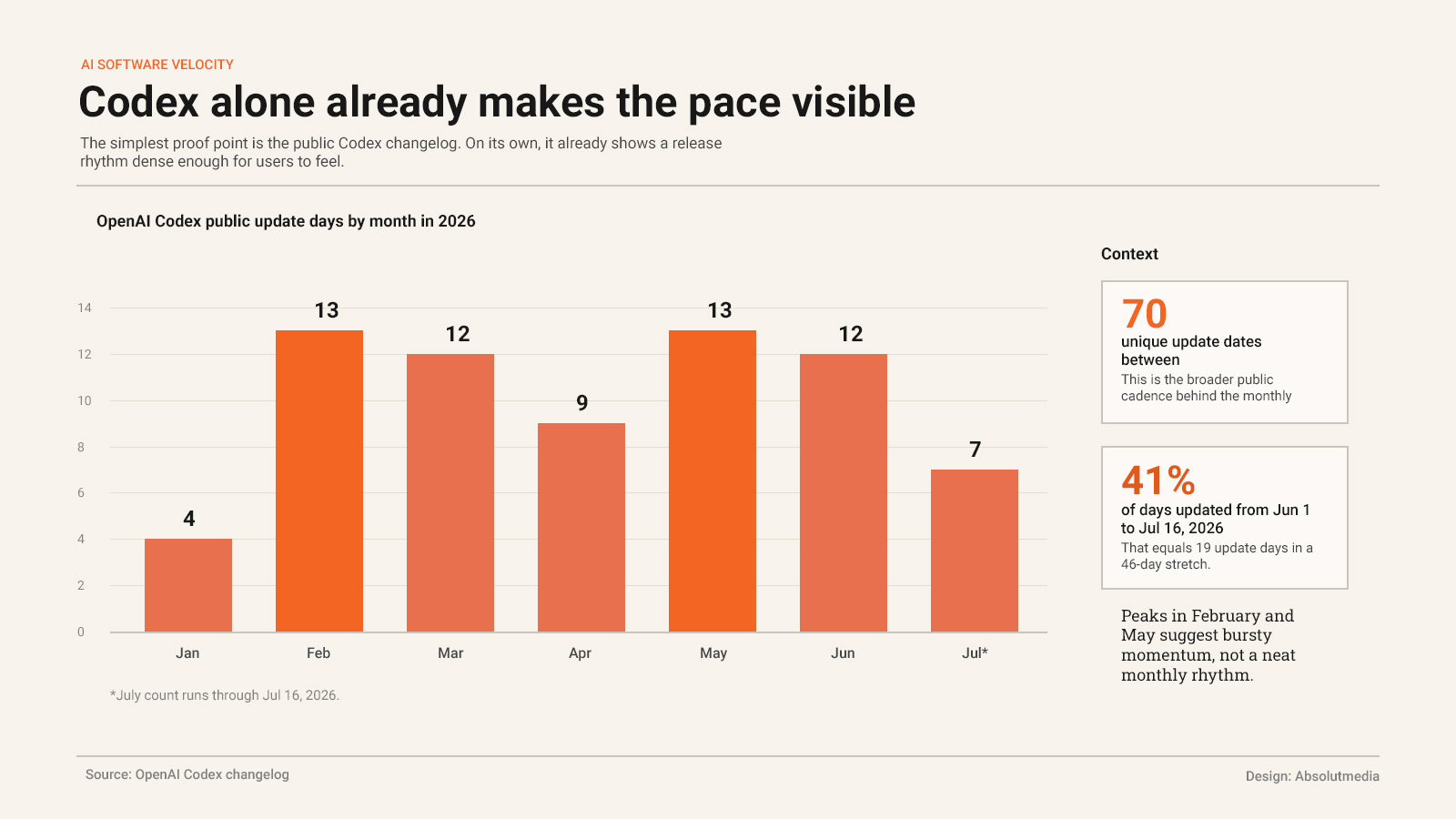
So yes, the pace feels faster because, in public and on paper, it is faster.
The tempting conclusion is that AI has finally become the magic shovel clearing product backlogs, bug queues, roadmap debt, and every engineering regret from the last five years. That is a charming story. It is also a little too close to hiring one intern and announcing the supply chain has been fixed.
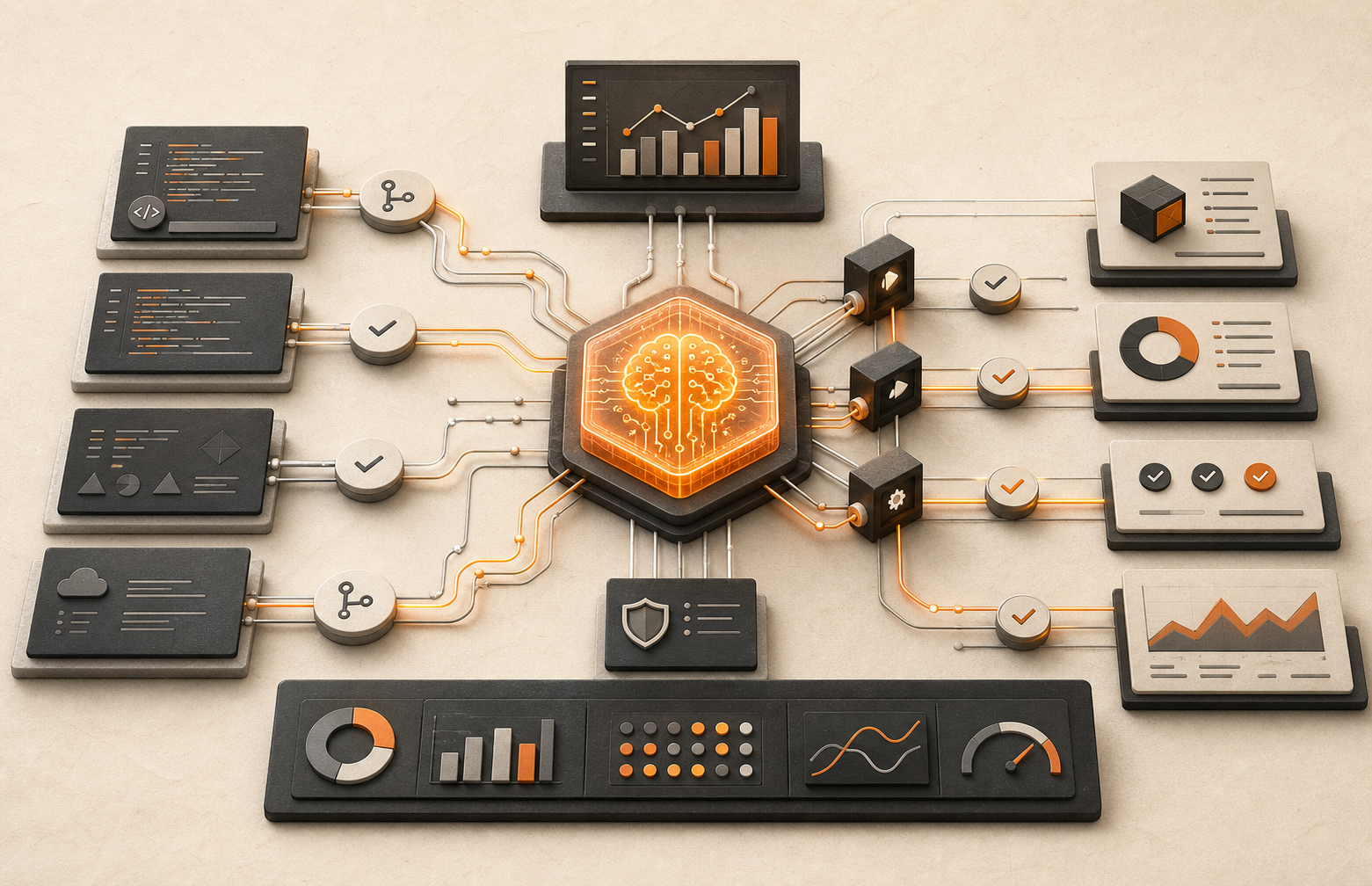
The more defensible thesis is better and more useful. AI is helping software teams move faster. It is compressing drafting, debugging, refactoring, review assistance, and experimentation cycles. But the companies that benefit most are not simply the ones using AI the loudest. They are the ones with enough operational discipline to survive their own acceleration.
That distinction matters.
GitHub’s controlled Copilot study found that developers completed a coding task 55.8% faster with AI assistance. That is not a rounding error. That is a meaningful shift in the economics of day-to-day software work. GitHub has also said Copilot has now helped users accept more than 3 billion code suggestions, serves 20 million-plus developers, and contributes to 1.2 million pull requests per month.
The broader market data points in the same direction. DORA’s 2025 State of AI-assisted Software Development report found that 90% of technology professionals use AI at work and more than 80% believe it has increased their productivity. GitHub’s enterprise research with Accenture found that over 80% of participants successfully adopted Copilot, 67% used it at least five days per week, 90% said they felt more fulfilled, and 95% said they enjoyed coding more with it.
In other words, we are no longer debating whether AI has entered the software workflow. That debate has left the building, probably with a keynote badge and a polished panel title.
The real question now is what kind of organization is holding the tool.
Because here is the part that gets buried under the confetti cannon: faster code generation does not automatically produce better software delivery. It can also produce faster messes.
DORA’s earlier Impact of Generative AI in Software Development report found that a 25% increase in AI adoption was associated with a 1.5% decrease in delivery throughput and a 7.2% decrease in delivery stability. That sounds backward until you think about how many organizations actually operate. If developers can generate more code more quickly, but testing is slow, code review is overloaded, architecture is brittle, and release governance still behaves like a group project nobody volunteered to lead, the extra speed does not become value. It becomes traffic.
DORA’s 2025 report refined the picture. It found that AI adoption had begun to show a positive relationship with software delivery throughput and product performance, which suggests teams and tools are getting better at integrating AI into real workflows. But even then, the report still found a negative relationship with stability. That is the key tension in one sentence: AI can absolutely help teams move faster, and it can still make the system wobble if the foundations are not solid.
This is why the most useful word in the DORA work is not acceleration. It is amplifier.
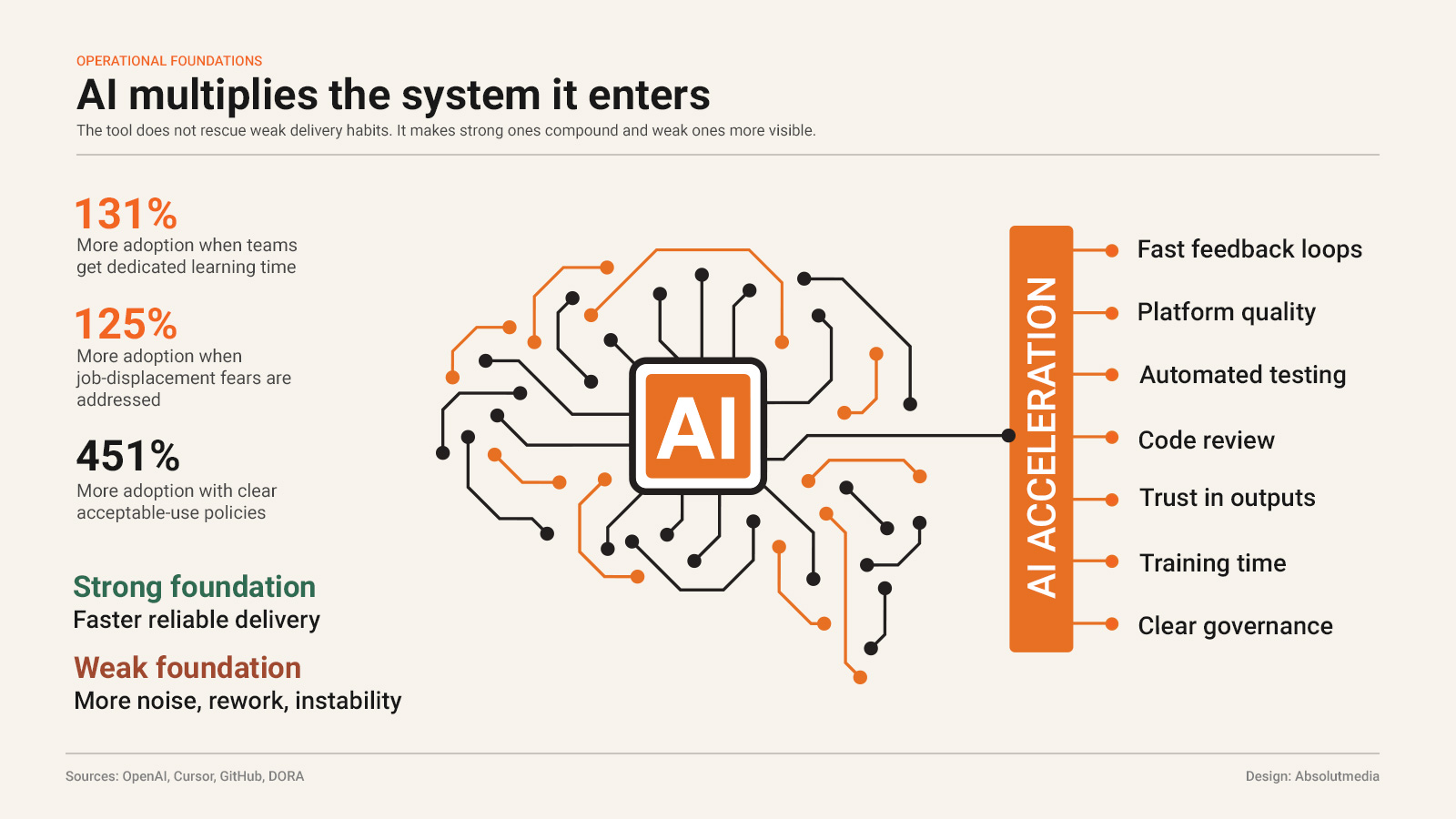
AI does not fix a weak delivery system. It amplifies whatever is already there.
If a company has strong internal platforms, disciplined engineering practices, solid testing, high-quality code review, and fast feedback loops, AI behaves like leverage. If a company has weak foundations, AI behaves more like giving a skateboard to someone who still has not learned where the stairs are.
This is also where a lot of executive AI strategy becomes accidentally comedic. Some organizations still talk about AI as if it were a replacement for engineering maturity, the way a teenager talks about buying supplements as a replacement for training. That is a very elegant theory for a very avoidable disappointment.
The data points toward a more sober model. DORA found that 90% of organizations have adopted at least one platform, and it reported a direct correlation between high-quality internal platforms and an organization’s ability to unlock the value of AI. In plain English: the plumbing matters. The glamorous demo is not the whole movie. If the workflow underneath is fragile, the result is not transformation. It is a more expensive version of chaos wearing better branding.
The organizational conditions matter just as much as the tooling. DORA found that organizations providing dedicated learning time saw 131% more team AI adoption. Organizations that directly addressed fears about job displacement saw 125% more team AI adoption. Organizations with clear acceptable-use policies showed a 451% increase in AI adoption.
That last number deserves special attention. A surprising amount of AI governance still operates on a strange combination of silence, wishful thinking, and “let’s just trust everyone to use common sense.” Clear policy does not just reduce risk. It increases useful adoption by telling teams what good use actually looks like.
Trust is another foundational issue that too many companies treat as soft and optional, right up until it becomes expensive. DORA found that 39% of developers trusted AI output only “a little” or “not at all,” and in the 2025 report 30% still reported little or no trust. That gap matters because distrust creates drag, while blind trust creates risk. Mature teams do not solve that problem with slogans. They solve it with review quality, automated testing, clear standards, and feedback loops that let people verify rather than merely believe.
That is the real operational story behind the burst of visible updates across AI-native companies. AI is compressing the cost of producing and revising software. It is making experimentation cheaper. It is helping teams draft faster, review faster, and move more work in parallel. But that does not flatten the importance of fundamentals. It makes fundamentals more important.
When the cost of generating change drops, the cost of managing change becomes the real differentiator.
That is why the winners of this cycle are unlikely to be the companies that shout “AI-first” the loudest or staple the most copilots to the most interfaces. The winners will be the companies that can absorb acceleration without losing control. The ones that know how to turn more output into reliable delivery. The ones that have enough structure to keep speed from becoming noise.
AI is changing software. That part is clear. The weaker claim is that it is automatically making software organizations better. The stronger one, and the one the data supports, is that AI is revealing which organizations were already built to scale judgment, process, and execution.
That is a less cinematic conclusion than “the bots ate the backlog.” It is also much closer to the truth.
Practical nugget: If a company wants more value from AI in software, the next dollar should not always go into another tool. Sometimes it should go into testing, internal platforms, release workflow, code review quality, training time, and governance clarity. The shiny layer gets the applause. The foundation gets the outcome.
If you want a practical place to continue, start with our AI Consulting lane and read it alongside AI Automation for Business Workflows: Where to Start Without Overbuilding and Scalable AI Operations: From Opportunity Discovery to Repeatable Business Systems.
How Absolutmedia approaches it
At Absolutmedia, we do not treat AI as a substitute for method. We treat it as leverage. That means we care as much about workflow design, trust, validation, and operating discipline as we do about the model or interface itself. The goal is not to generate more activity. The goal is to generate more reliable value.
In practice, that means building AI-enabled systems that can actually survive contact with real work: clear processes, explicit guardrails, review logic, and enough structure that speed improves outcomes instead of simply increasing the size of the cleanup crew.
Next step
If your company is adopting AI in product, operations, or software workflows, the smartest question is not “How fast can this tool go?” It is “What foundation do we have underneath that speed?” That is where the real advantage lives, and where most of the preventable mistakes quietly begin.
Sources
- OpenAI Codex changelog
- Cursor changelog
- GitHub Copilot changelog
- The Impact of AI on Developer Productivity: Evidence from GitHub Copilot
- Research: Quantifying GitHub Copilot’s impact in the enterprise with Accenture
- GitHub Copilot: Faster, smarter, and built for how you work now
- Announcing the 2025 DORA Report
- Impact of Generative AI in Software Development
- Trust in AI