A lot of AI conversations begin too late.
They begin when someone asks which model to use, which platform to subscribe to, or how quickly a team can automate a task. By that point, the most important questions have often already been skipped. What exactly is the business problem? Where does the workflow break? Which decision still needs human judgment? Who owns the outcome when the system gets something wrong?
That is why sustainable AI does not start with the tool. It starts before the tool.
For companies exploring AI automation, this matters more than most vendor demos suggest. A model can generate output fast. It cannot, by itself, define a sound operating method, assign accountability, or decide where trust should remain human. If those parts are still blurry, automation does not remove risk. It usually hides it inside speed.
The practical mistake is common: teams try to automate a task before they map the decision behind the task.
The workflow matters more than the demo
When AI projects go wrong, the failure is rarely just technical. More often, the underlying workflow was never clear enough to automate responsibly in the first place.
Maybe a sales team wants AI help with proposals. Maybe an operations team wants to summarize service reports. Maybe marketing wants to accelerate content production. In each case, the surface task looks automatable. But the real question is deeper: what chain of judgment, review, context, and approval turns that task into something trustworthy?
If the workflow is inconsistent, undocumented, or owned by nobody in particular, AI will not fix that. It will scale the inconsistency.
This is one reason the NIST AI Risk Management Framework remains useful beyond large enterprise governance conversations. Its value is not only in formal policy language. It reminds organizations that AI risk is connected to context, measurement, oversight, and real-world use, not just model performance.
The same principle appears in the OECD AI Principles: trustworthy AI depends on accountability, transparency, and human-centered design. In practice, that means AI adoption has to be designed into a real system of work.
Where judgment should stay
Not every part of a workflow deserves the same level of automation.
Some steps are repetitive and low-risk. Those are usually good candidates for AI assistance. Other steps involve interpretation, approval, exceptions, edge cases, or relationship-sensitive decisions. Those are the points where human judgment should stay visible.
This is where many teams need to slow down just enough to think clearly. They do not need a 90-page governance document before they experiment. But they do need to know where a person remains responsible.
Practical nugget: map the decision before you automate the task.
That sounds simple, but it changes the conversation. Instead of asking, “Can AI do this?” the team starts asking:
- What outcome are we trying to improve?
- What information does this step depend on?
- Where can the system be wrong?
- Who reviews the result?
- Who decides whether the output is good enough to act on?
Those questions turn AI from a novelty into a design problem. That is a healthier starting point.
Ownership is part of the system
One of the least glamorous parts of AI adoption is also one of the most important: ownership.
If nobody owns the workflow, nobody really owns the AI risk either.
That does not mean every company needs a formal AI department before doing useful work. It means a real person or team should be responsible for the process being improved. Someone needs to understand the workflow, define what success looks like, review failure modes, and decide what happens when the system produces weak output.
This is especially important when AI enters workflows that affect client communication, brand voice, approvals, pricing, documentation, service quality, or operational decisions. In those cases, the output is not just content or speed. It is trust.
At Absolutmedia, we keep coming back to the same principle we discussed in Scalable AI Operations: From Opportunity Discovery to Repeatable Business Systems: structure comes before scale. The same applies to AI. A workflow with no clear structure does not become intelligent because a model touches it.
Human review is not a temporary patch
There is still a tendency in some AI conversations to treat human review as a short-term compromise, as if the mature version of the system should eventually remove people from the loop entirely.
In many business contexts, that is the wrong ambition.
Human review is often a product feature. It is the point where context, ethics, nuance, exception handling, and business responsibility remain intact. Removing that layer too early can make a system look efficient while quietly making it brittle.
This is why AI automation should be framed as system design, not just task acceleration. The goal is not to eliminate every human touch. The goal is to make work move better without losing accountability, clarity, or control.
That is also why a thoughtful workflow matters before implementation. In a good system, AI supports the process without becoming a black box inside it.
If you want a more implementation-focused view of that idea, our piece on AI automation for business workflows goes deeper into where to start without overbuilding.
What sustainable AI adoption looks like in practice
In practical terms, sustainable AI adoption usually begins with a smaller and more disciplined move than people expect.
It often looks like this:
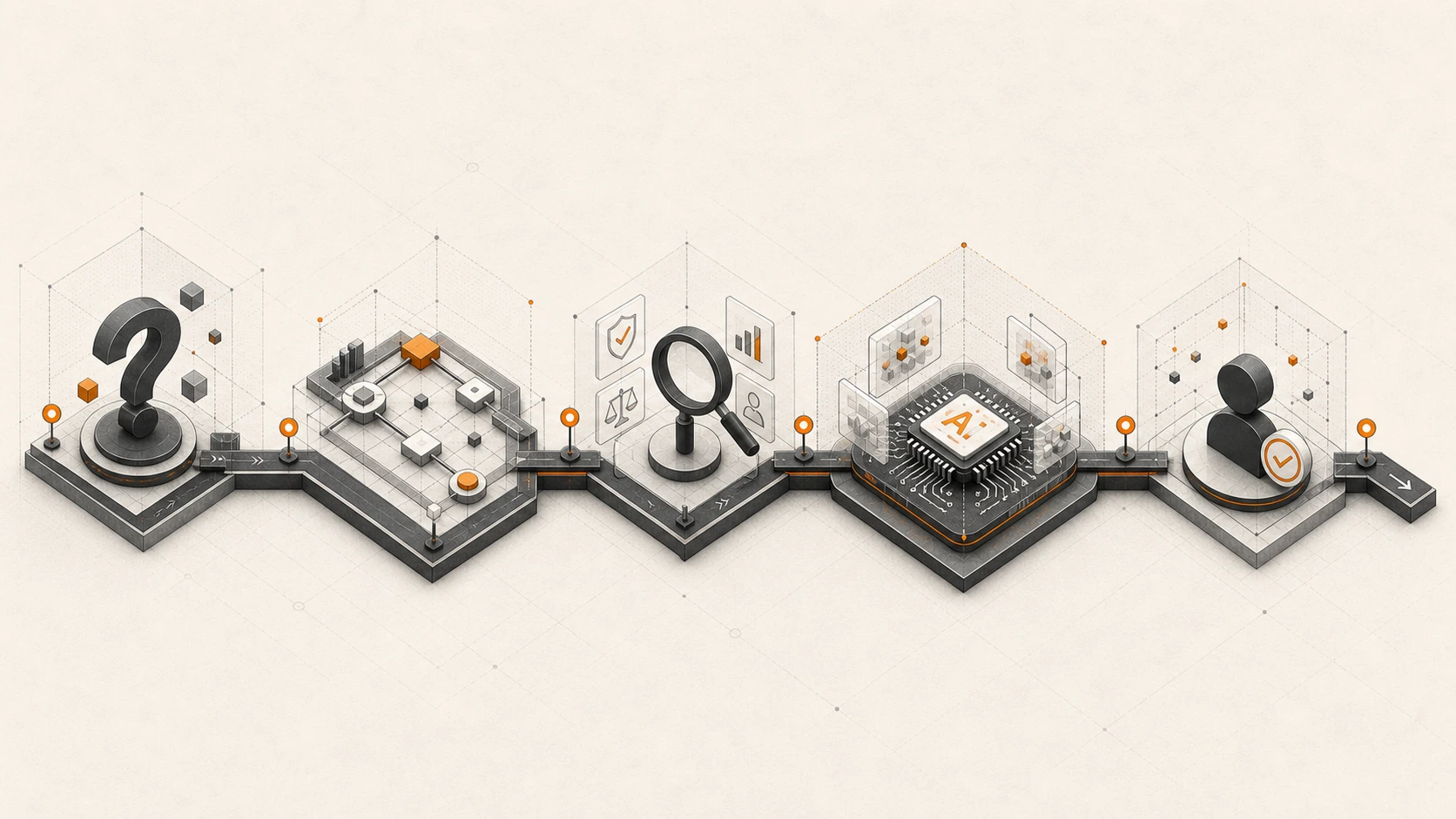
- Define the business problem before choosing a tool.
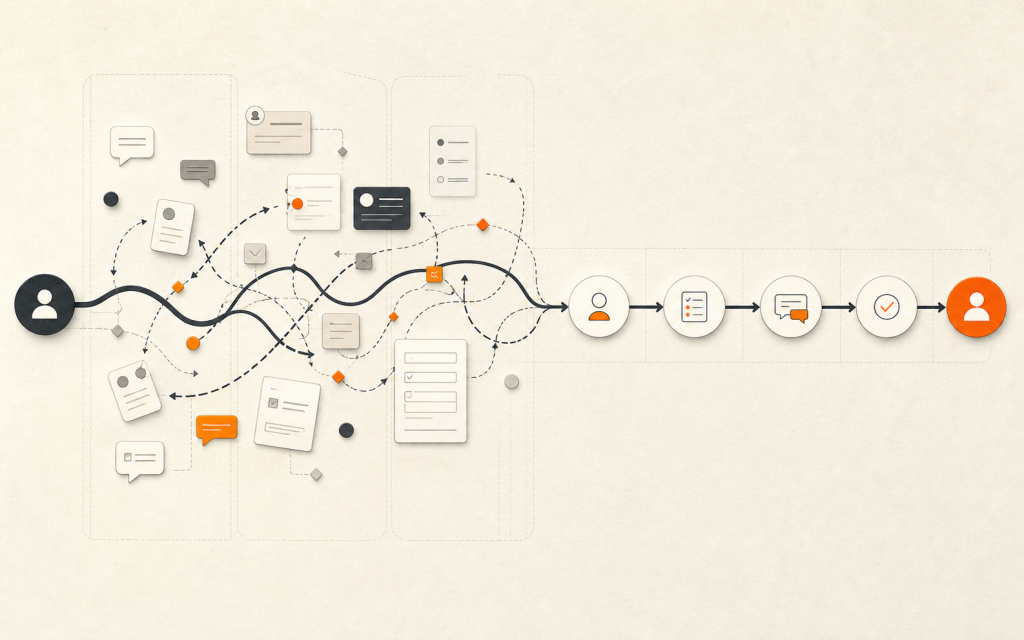
- Map the current workflow, including handoffs and exceptions.
- Identify which step is repetitive enough to support with AI.
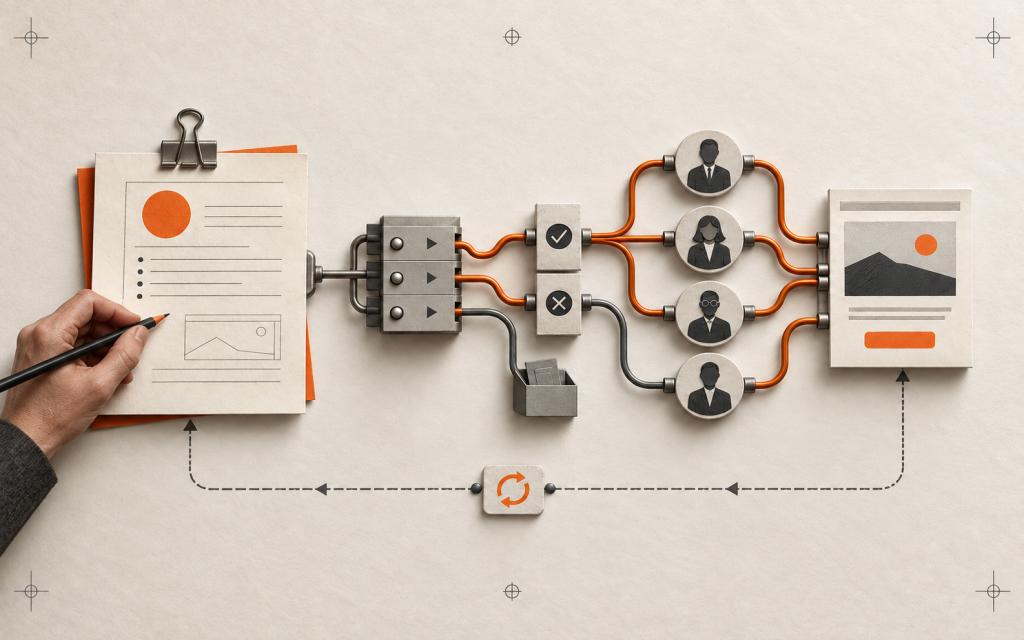
- Keep review visible, especially where quality or risk matters.
- Assign ownership for outputs, corrections, and iteration.
- Improve the system in loops instead of pretending the first version will be perfect.
This is slower than hype, but faster than rework.
It also tends to produce better long-term results because the organization learns where AI is actually useful instead of forcing it into places where the workflow was never ready.
How Absolutmedia approaches it
We do not treat AI adoption as a model-selection exercise first. We start by looking at the operating reality behind the request: the workflow, the decision points, the friction, the approval logic, the content or service risk, and the people responsible for the outcome.
That approach helps us design AI-enabled digital systems that stay practical. Sometimes the right move is automation. Sometimes it is better interface design. Sometimes it is clearer content structure, stronger workflow ownership, or a more disciplined first version.
The point is not to add AI everywhere. The point is to make useful systems that support real work without outsourcing judgment.
Next step
Before your team automates the next task, pause and map one level deeper.
Do not start with the prompt. Start with the decision.
If you can clearly define the workflow, the review point, the owner, and the moment where human judgment still matters, you are in a much better position to use AI well.
And if those parts are still unclear, that is not a reason to give up. It is the real starting point.