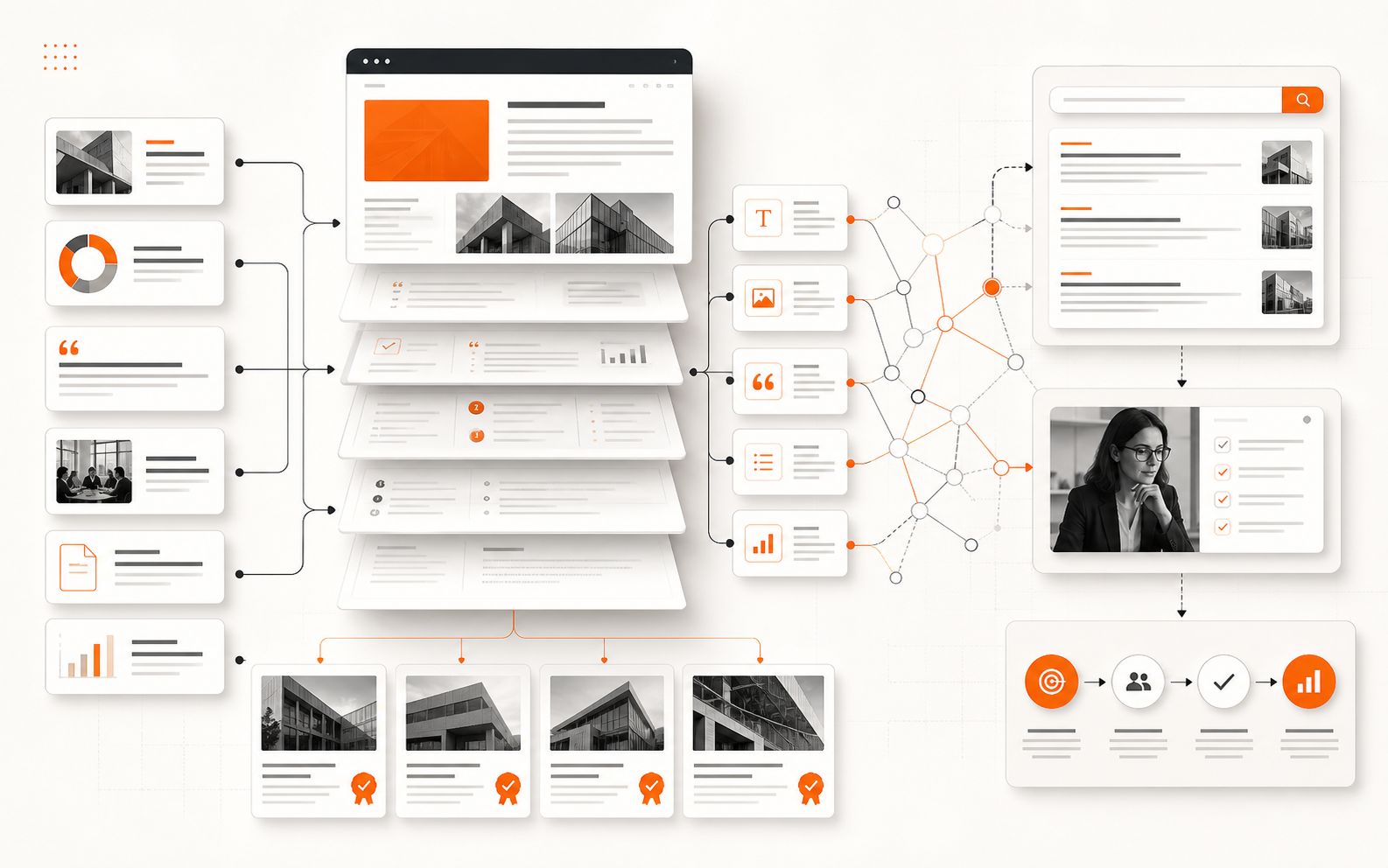
For years, the business website had a comforting job description: sit in the middle of the internet wearing a nice suit, receive visitors from Google, explain the company, and try to convert a few of them before they wandered off to compare five competitors and forget their own password.
That job still exists. But it is no longer the whole job.
AI search is changing the role of the website. Google is expanding AI Mode and AI-powered search experiences, and its own guidance now speaks directly to how website owners should think about generative AI features in Search. The uncomfortable translation is simple: your website is no longer only a destination. It is also source material.
Not in the vague “content is king” way that has haunted marketing decks since the early 2000s, wearing a tiny crown and asking for a keyword cluster. I mean something more operational: your pages are now evidence that search systems, answer engines, assistants, and buyers may use to understand what your company does before the visit ever happens.
The homepage used to be the lobby. Now it is also the witness statement. If it says nothing useful, AI search has no reason to remember you.
That does not mean websites are dead. It means weak websites are being promoted from ineffective brochures to ineffective training material—a very elegant demotion.
The click is no longer guaranteed
The old search logic was easy to explain. A person searched. Google listed results. The person clicked. The website took over from there.
That model still exists, but it is losing its monopoly. Google describes AI Mode as a more powerful AI search experience that lets people ask more complex questions and continue with follow-ups. Google Search Central also tells website owners to focus on the same durable basics that help systems understand and present useful content: accessible pages, helpful information, clear structure, strong page experience, and content that people can actually use.
That last part matters. When a user asks an AI search experience to compare options, explain a process, shortlist vendors, or answer a practical business question, the website may influence the answer without receiving the visit. This is not traditional search wearing a new hat. This is search doing the reading for the user and then giving a summary with the confidence of a junior consultant who discovered bullet points.
Pew Research Center found in 2025 that users who encountered a Google AI summary clicked traditional search result links less often than users who did not encounter one. The numbers in that study are not a small mood change. They point to a behavior shift: when answers appear earlier, fewer people continue to the original pages.
This is where some marketing conversations become theatrical. One camp declares SEO dead, dramatically removes its sunglasses, and waits for the camera to zoom in. Another camp insists nothing has changed because Google still says good content matters. Both are missing the useful middle.
SEO is not dead. But “ranking and waiting for the click” is no longer enough as a strategy.
Practical nugget: If your website only makes sense after someone lands on it, it is underbuilt for AI search. The content has to be understandable as evidence, not only persuasive as a page.
Your website is becoming an evidence layer
A strong website used to answer a visitor’s questions. A stronger website now has to answer questions for several readers at once:
- The human buyer who wants confidence
- The search engine trying to understand entities, relationships, and usefulness
- The AI system summarizing your category
- The internal team that needs consistency across sales, support, content, and delivery
- The skeptical stakeholder who does not care about your animation curve and wants proof
This changes what “good web content” means.
A beautiful homepage that says “we empower transformation through innovative solutions” is not a positioning statement. It is fog with a logo. AI systems cannot extract much from it. Human buyers cannot either. Everyone leaves with the same feeling they get from a motivational poster in a rented conference room.
The better question is not “Does this page sound premium?” The better question is:
Can this page prove what we do, who we do it for, how we think, what decisions we help people make, and why we are credible?
That is why content architecture matters. Service pages should not be a parade of adjectives. They should define the problem, the operating context, the decision points, the process, the outcomes, and the boundaries. Case studies should not behave like red carpet photos for the agency. They should show evidence: constraints, choices, tradeoffs, implementation logic, and results where available.
If your content cannot survive being summarized, compared, quoted, or partially extracted, then the problem is not AI search. The problem is that the website was already thin. AI just read it faster.
This is a bit like Jurassic Park. The dinosaurs were not the real issue. The issue was the shocking belief that a complex system could be controlled with confidence, branding, and one underpaid person at a computer. AI search is exposing the same problem in digital presence: companies built fragile systems and then acted surprised when the environment changed.
The brochure website is aging badly
The brochure website survived for a long time because it could hide behind traffic. If the homepage looked decent, the services sounded professional, and the contact form worked, the site could be considered acceptable. Not great, but acceptable. Like a hotel breakfast that technically includes fruit.
AI search is less forgiving because it rewards clarity at the level of information, not only polish at the level of presentation.
A brochure website usually has these symptoms:
- Generic service descriptions
- Weak author or company expertise signals
- No clear explanation of process
- Thin examples
- Disconnected blog posts
- Little structured internal linking
- Content that avoids saying anything specific in case specificity scares someone
That last one is the silent killer. Many businesses sand down their content until it becomes smooth, agreeable, and functionally invisible. The result reads like it was approved by every character in The Office who wanted the meeting to end.
In the old web, that content could still catch a click if the ranking worked. In the AI search era, vague content has a new problem: it gives the machine very little to understand and the buyer very little to trust.
Google’s own AI feature guidance for site owners keeps returning to fundamentals: make content accessible, useful, relevant, and technically available for Search. That is not a secret code for “write for robots.” It is a reminder that systems can only represent what your site makes legible.
Legibility is now a business asset.
Traffic is not the only signal of value
This is the part that makes dashboards uncomfortable.
Many teams are trained to evaluate web performance by traffic, rankings, and conversions. Those still matter. But AI search introduces visibility patterns that may not appear cleanly as classic referral traffic.
Cloudflare has been documenting the gap between AI crawling and referral behavior. Its work on the crawl-to-click gap shows why site owners are starting to ask a sharper question: which automated systems are reading my content, and which ones are sending value back?
Cloudflare’s 2026 controls for AI traffic also reflect a more mature distinction: not all AI bots behave the same way. Some are associated with search, some with agents, some with training. That distinction matters because the business decision is not simply “block AI” or “allow AI.” That is too blunt. It is the website strategy equivalent of solving a kitchen fire with a bulldozer.
The smarter question is:
What forms of machine access support discoverability, and what forms only extract value without creating a useful return?
This will become part of web governance. Not just SEO. Not just IT. Not just content. Governance.
The website is becoming a managed knowledge surface. It needs technical controls, editorial standards, semantic clarity, content maintenance, and measurement that goes beyond “Did the blog post get clicks this week?”
That sounds less glamorous than launching a shiny redesign. So does flossing. Both prevent expensive problems.
What should change in the way teams build websites?
The answer is not to panic-rewrite every page into a robot-friendly encyclopedia. Please do not turn your brand into Wikipedia wearing a blazer.
The answer is to make the website more useful, more structured, and more evidential.
Start with positioning. The site should make it painfully clear what the company does, for whom, in what context, and with what kind of method. If a reader has to visit six pages to understand the basic offer, that is not depth. That is a scavenger hunt.
Then clarify the service architecture. Strong service pages should explain the business problem, the situations where the service is relevant, the decisions involved, the workflow, the deliverables, the risks, and the next step. This helps humans decide and helps systems understand.
Build proof into the structure. Not every company has perfect case studies, but every serious company has evidence: process details, examples, before-and-after thinking, constraints, screenshots, diagrams, lessons, implementation notes, partner context, or operational outcomes. Evidence does not always need fireworks. Sometimes it needs a clear explanation and the courage to be specific.
Connect the content. Blog posts, service pages, category pages, project examples, and calls to action should reinforce each other. A disconnected blog is just a drawer full of polite essays. A connected content system teaches both people and machines how the company thinks.
Make the technical layer boring in the best possible way. Crawlable pages, clean headings, internal links, schema where appropriate, readable layouts, fast performance, and accessible content are not glamour features. They are plumbing. James Bond does not talk about plumbing, but even he needs the building not to flood.
Finally, maintain the website like a system. AI search makes stale, thin, conflicting content more costly. If the company has evolved but the website still describes an older version of the business, the market is not confused. The website is.
The real shift: from web presence to web credibility
For a long time, “having a website” was enough to be present. Then the game became ranking. Then conversion. Then content. Then experience. Now we are moving toward something more demanding: credibility that can be understood across systems.
That is a healthier standard.
It means the website has to carry strategic weight. It has to explain the business clearly enough for buyers, search systems, AI summaries, sales teams, and internal stakeholders to build the same mental model.
This is where AI search should make teams more disciplined, not more frantic. The negative reaction is to chase every new acronym: AEO, GEO, LLMO, and whatever arrives next week wearing a conference badge. Some of those practices are useful. The naming circus is optional.
The better reaction is to ask:
- Are our pages specific enough to be cited?
- Is our expertise visible?
- Do our service pages explain decisions, not only offerings?
- Does our content show how we think?
- Can a buyer understand our difference without a sales call?
- Can an AI system summarize us accurately without hallucinating a completely different company?
That last question is more important than it sounds. If AI systems are going to describe your business, you should at least give them something accurate to work with. Otherwise you are letting the internet play Mad Libs with your positioning.
How Absolutmedia approaches it
At Absolutmedia, we treat the website as part of a larger digital system: strategy, UX/UI, content architecture, technical implementation, AI adoption, and media language working together.
That matters because the AI search era does not reward isolated pieces. A good article cannot compensate forever for weak service pages. A beautiful homepage cannot fix unclear positioning. A chatbot cannot rescue a content model that says nothing. This is not The Avengers, where everyone arrives separately, and somehow the city gets saved in the third act.
Our approach starts by clarifying the business problem, the audience, the operational context, and the decisions the website needs to support. Then we shape the information architecture, service narratives, interface logic, proof points, and technical structure around that reality.
The goal is not to make websites louder. The goal is to make them more legible, useful, credible, and ready to operate in a world where humans and machines both read before they decide.
Next step
If your website still behaves like a digital brochure, start with one practical audit: choose a core service page and ask whether it clearly explains the problem, audience, method, proof, and next step.
If the answer is “sort of,” that usually means no.
Bring that page into a strategy conversation. The next version of your website does not need to chase every AI search trend. It needs to become better evidence.