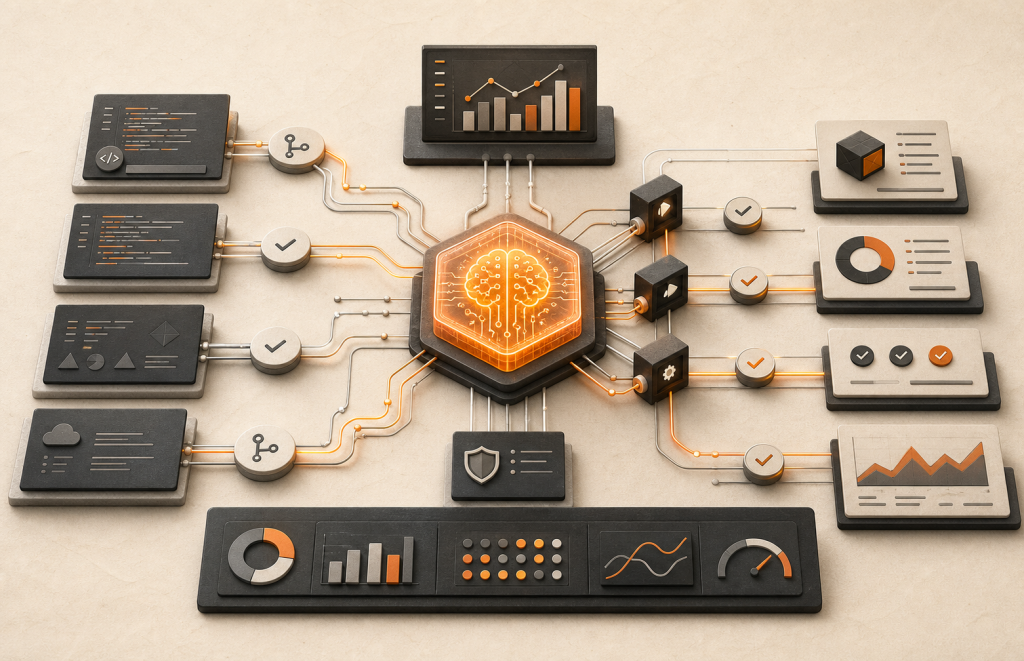
An AI-enabled digital system should make a team more capable, not less aware of how decisions are being made. That distinction matters.
AI can summarize, classify, draft, recommend, search, route, and accelerate. But when it is placed inside a business workflow, the question is no longer “Can the model do this?” The better question is “How does the system help people make better decisions with the right amount of control?”
The steering wheel still matters
An AI-enabled system without clear human control is like a very confident car with no visible steering wheel. It may move. It may even move fast. But nobody in the organization feels relaxed when the road gets complicated.
Human control is not nostalgia. It is product design. The user needs to know what the system did, why it suggested something, what evidence it used, and where a person can intervene. That is especially important when AI is touching client communication, operational decisions, internal knowledge, or anything that could create reputational risk.
The NIST AI RMF Playbook is useful because it translates the broader AI Risk Management Framework into suggested actions around governing, mapping, measuring, and managing AI risks. The playbook is not a magic checklist, but it gives teams a better vocabulary for building control into the system.
Practical nugget: Do not hide the steering wheel to make the system feel advanced. Make control visible so the system feels trustworthy.
Human control is not a blocker
There is a lazy version of the AI conversation that treats human review as friction. In real operations, human review is often the feature that makes adoption possible.
Clients need confidence. Professionals need traceability. Teams need to know when AI is suggesting, when it is acting, what data it used, and where a person can approve or correct the output.
Practical nugget: Put the human review point where the cost of being wrong starts to matter.
The NIST AI Risk Management Framework is useful because it frames AI around governance, measurement, and risk management. That is exactly the mindset needed for business systems.
The system around the model matters most
An AI feature by itself is not a product. The product includes the input, context, permissions, prompt or retrieval strategy, output review, logging, analytics, escalation, and user experience around the feature.
For example, an AI assistant that drafts a client response may be valuable. But the real system includes the source material it can use, the tone rules it follows, the review workflow, the approval status, and the way the final message is stored.
This is where our digital systems work connects with AI services. The AI capability should be embedded into a workflow that makes sense.
Design for confidence, not magic
Users should understand what the AI did and what they are expected to do next. A good interface may show source references, confidence signals, edit options, version history, or a clear approval step. It may also limit what AI can do automatically until the team has enough evidence to expand.
Google’s AI principles are a useful external reference because they emphasize accountability, safety, and avoiding harmful use. Even when the system is internal, those principles keep the work grounded.
Confidence is built through feedback loops
AI systems improve in the real world when teams pay attention to the correction layer. Where did people edit the output? What suggestions were ignored? Which source was missing? Which exception appeared twice in the same week? That feedback is gold, but only if the system is designed to capture it.
This is where human-centered AI principles become practical. The OECD AI Principles emphasize trustworthy AI that respects human-centered values. In product terms, that means the interface should not pressure users to accept an output just because the machine sounds confident.
The Stanford HAI AI Index is also a reminder that adoption is accelerating. As AI becomes normal, the competitive difference will not be who added AI first. It will be who made AI useful, reliable, and understandable inside the actual work.
Start with one controlled loop
The first AI-enabled system does not need to transform the whole company. It can improve one loop: intake to summary, document to recommendation, meeting to action list, content brief to draft, support request to routing, or sales note to proposal outline.
The key is to measure the loop. Did it save time? Did quality improve? Where did people correct the output? What exceptions appeared? That feedback becomes the next version.
Related reading: AI Automation for Business Workflows and UX/UI Design Systems.
How Absolutmedia approaches it
We design AI-enabled systems around workflow, accountability, and practical adoption. We define what AI should support, where human judgment stays in control, and how the interface makes the system understandable instead of mysterious.
Next step
If you want to use AI inside a real business process, start by choosing one workflow where better speed and structure would matter. Then explore it through Absolutmedia’s AI services so the system is designed with control from the beginning.