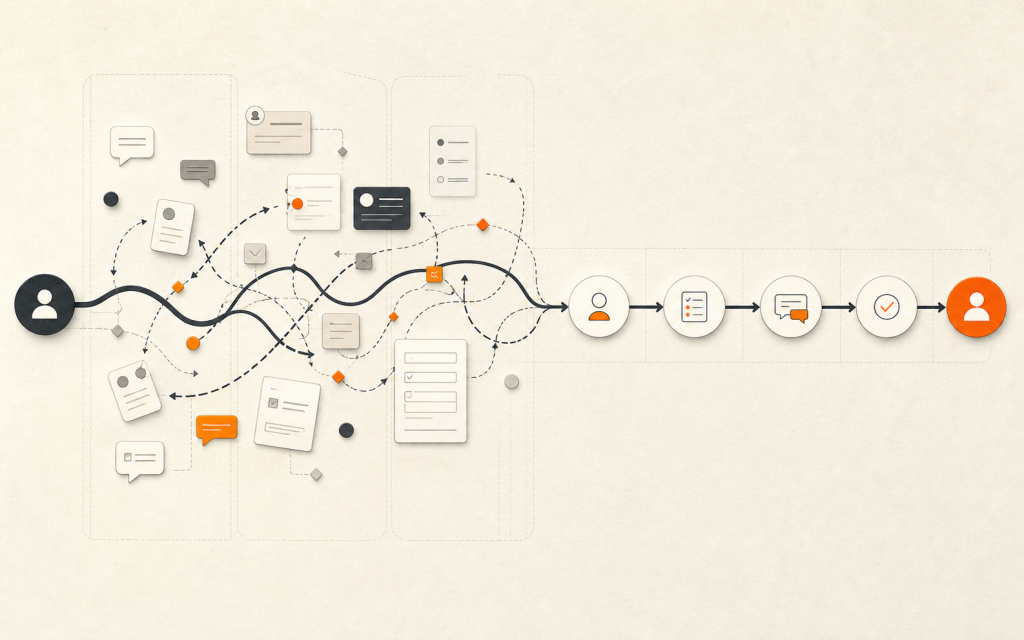
Technical teams often have strong ideas trapped inside weak presentations. The work is solid. The logic is there. The opportunity is real. But the story does not help decision-makers understand what matters, what is at stake, and what should happen next.
That is why I like the phrase “executive presentation system.” It is not just a deck. It is a repeatable way to turn complex thinking into a decision-ready story.
Executives do not need less detail. They need better structure.
A common mistake is assuming that leadership only wants a simplified version. In reality, decision-makers need enough detail to trust the recommendation, but organized around the decision they are being asked to make.
That means the presentation has to frame the problem, show the context, explain the options, make the tradeoffs visible, and lead to a clear recommendation.
Practical nugget: A presentation is decision-ready when the audience can explain the recommendation, the reason, and the risk without needing the presenter in the room.
Technical ideas need translation, not decoration
3D visuals, diagrams, motion, and polished slides can help, but only if they clarify the idea. A beautiful deck that hides the logic is still weak. A rough deck with a clear argument is already closer to useful.
The best presentation systems combine narrative, visual hierarchy, evidence, and reusable modules. Teams should not rebuild the story from scratch every time they need approval, funding, alignment, or sales support.
This connects directly to Absolutmedia’s media production and digital systems work. The same method can support product launches, investor conversations, sales enablement, internal strategy, and technical explainers.
How people actually consume presentations
Decision-makers scan. They compare. They look for risk. They ask what changes if they say yes. The Nielsen Norman Group’s work on scanning behavior is useful beyond websites because it reminds us that people rarely consume information linearly when they are busy.
For presentation systems, that means strong titles, clear visual hierarchy, useful summaries, and slides that can survive being forwarded without narration.
Google’s people-first content guidance reinforces the same editorial principle: usefulness has to lead. The presentation exists to help someone understand and decide.
Build the system, not just the deck
A useful executive presentation system may include narrative frameworks, reusable slide patterns, data visualization rules, product diagrams, before-and-after structures, objection slides, appendix logic, and visual standards for how the brand communicates complex ideas.
For professionals, the system protects quality. For clients, it reduces the stress of turning technical work into business language every time an opportunity appears.
Related reading: Media Production for Product Launches and Digital Product Strategy.
How Absolutmedia approaches it
We approach executive presentations as communication architecture. We clarify the decision, shape the narrative, design the visual system, and create assets that make technical ideas easier to understand, trust, and act on.
Next step
If your team has a strong technical idea but the story is not landing, start by writing the decision you need the audience to make. Then use Absolutmedia to shape the presentation system around that decision.