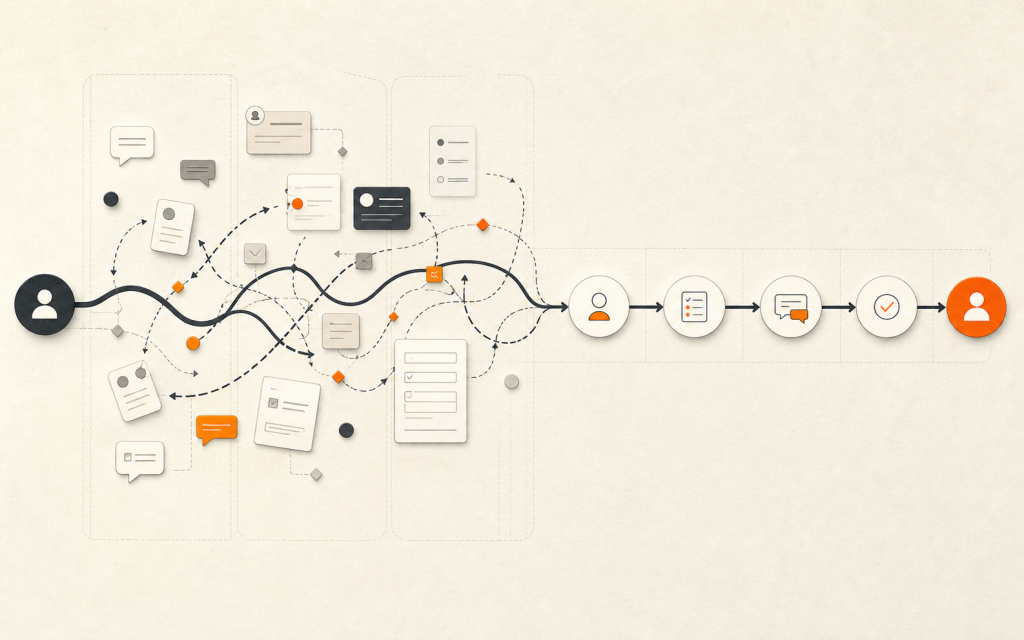
A strong digital product strategy is not a prettier version of a feature list. It is the bridge between a business problem, a user workflow, and the system that will eventually have to survive real operations.
After more than two decades working across web development, branding, and project management, one pattern keeps repeating: teams do not usually fail because the idea was bad. They fail because the idea was never translated into a system. The conversation jumps from excitement to screens, from screens to estimates, and from estimates to a build that now has to absorb every undefined decision.
That is where strategy earns its place. Not as a presentation exercise, but as a way to reduce expensive ambiguity.
Start with the operating problem, not the interface
Before wireframes, platforms, automations, or AI features, the useful question is simple: what has to become easier, faster, clearer, or more reliable for this business?
A service company may need a client portal. A sales team may need a better quoting workflow. A production team may need to coordinate assets, approvals, and delivery. Those are not just design problems. They are operating problems with interfaces attached to them.
Practical nugget: If the product idea cannot be described as a workflow with inputs, decisions, owners, and outputs, it is not ready to become software yet.
This is why we connect strategy with the way Absolutmedia thinks about digital systems and services. The product is never only the page, the app, or the dashboard. It is the chain of decisions behind it.
Strategy is where the messy room gets a floor plan
Most product ideas begin as a messy room. There are valuable things inside: customer pain, internal knowledge, a strong offer, a half-built workflow, a few good sketches, and somebody’s strong opinion from a meeting three Tuesdays ago. Strategy does not throw the room away. It gives it a floor plan.
That floor plan matters because digital work is full of hidden dependencies. A marketing promise creates a content requirement. A content requirement creates an admin workflow. An admin workflow creates permissions. Permissions create interface states. Interface states create development scope. Scope creates budget. The dominoes are already standing there; strategy simply turns the lights on before anyone starts running through the room.
Harvard Business School’s digital transformation work makes a useful point for leaders: transformation is more about people, governance, and operating change than the technology alone. That aligns with what happens in product strategy. The system succeeds when the organization can actually use it, maintain it, and learn from it. See Harvard Business School Working Knowledge on digital transformation.
Practical nugget: The first deliverable of strategy is not a roadmap. It is shared language. If the team uses the same words for users, workflows, roles, and outcomes, the build gets dramatically less mysterious.
Scalable does not mean complicated
People often hear “scalable” and imagine enterprise architecture, heavy process, or a bigger budget. In early product strategy, scalable usually means something more practical: the system can grow without forcing the team to rebuild the same thinking every three months.
That means naming the core entities, the user roles, the content model, the approval flow, the integrations, and the parts of the experience that should stay consistent as the product expands. A small but well-structured product can scale better than a large but improvised one.
For professionals, this is where the craft becomes visible. A good architecture does not only support the first release. It protects the next version from the shortcuts of the first one.
The method before the roadmap
A useful digital product strategy usually clarifies five things before the build begins:
- The business outcome the system must support.
- The people who will use it, operate it, approve it, and maintain it.
- The moments where the current workflow breaks down.
- The data, content, and integrations the product depends on.
- The smallest version that can prove the idea without pretending to be final.
Google’s guidance around creating helpful content is useful even outside SEO: content should be made for people first, with real usefulness and clarity. The same principle applies to product strategy. See Google Search Central’s people-first content guidance for that broader principle.
When AI enters the conversation, the need for method becomes even stronger. AI can speed up drafting, classification, search, support, and internal decision flows, but it also makes sloppy systems faster at producing sloppy results. The NIST AI Risk Management Framework is a useful reminder that AI work needs governance, measurement, and accountability, not only prompts.
Discovery should produce decisions, not theater
Discovery has a bad reputation when it becomes a ceremony. Nobody needs four weeks of workshops to discover that the team is busy and the spreadsheet is sad. A useful discovery phase should create decisions: what matters now, what can wait, what needs proof, what is risky, and what would make the first version successful.
The GOV.UK Service Manual’s agile delivery guidance is a helpful reference because it treats delivery as stages of learning: discovery, alpha, beta, live, and retirement. That language is useful outside government too. It reminds us that a product is not born complete. It earns clarity through the right sequence of decisions.
For clients, that means not every request belongs in the first build. For professionals, it means pushing back with care when a feature looks useful but has no operating owner, no measurable outcome, and no place in the first learning loop.
Where teams usually overbuild
The most common mistake is trying to design the final product before the first version has taught the team anything. Strategy should create enough structure to build confidently, but not so much fantasy that the project becomes a monument to assumptions.
A better approach is to define a release that can carry the product’s main promise, then identify what must be true for the next layer to make sense. That may mean starting with a web app before mobile, a guided workflow before full automation, or a focused dashboard before a complex analytics system.
Related reading inside the blog: Web App Development for Enterprise Workflows and How to Build an AI-Enabled Digital System Without Losing Human Control.
How Absolutmedia approaches it
We treat digital product strategy as a working method: clarify the business outcome, map the workflow, define the user experience, shape the content and data model, and then decide what technology should exist. The goal is not to make the idea sound bigger. The goal is to make it buildable, useful, and easier to evolve.
Next step
If you are carrying an idea that feels valuable but still unclear, start by mapping the workflow behind it. Then bring it into a conversation through the Absolutmedia process or start a project so we can turn the concept into a practical first version.